
- What we are
- Key takeaways
- What is a customer communications platform, and what does it actually include?
- How is a customer communications platform different from UCaaS, CCaaS, and a CRM?
- What does channel fragmentation actually cost a sales or support team?
- Does your business need a customer communications platform?
- What should a customer communications platform include in 2026?
- How does a customer communications platform unify voice, SMS, and CRM in practice?
- What about data governance and compliance for a customer communications platform?
- Frequently asked questions
- What is the right question to ask before evaluating any platform?

Ready to build better conversations?
Simple to set up. Easy to use. Powerful integrations.
Get free access- What we are
- Key takeaways
- What is a customer communications platform, and what does it actually include?
- How is a customer communications platform different from UCaaS, CCaaS, and a CRM?
- What does channel fragmentation actually cost a sales or support team?
- Does your business need a customer communications platform?
- What should a customer communications platform include in 2026?
- How does a customer communications platform unify voice, SMS, and CRM in practice?
- What about data governance and compliance for a customer communications platform?
- Frequently asked questions
- What is the right question to ask before evaluating any platform?
Ready to build better conversations?
Simple to set up. Easy to use. Powerful integrations.
Get free accessA customer calls. The rep answers and checks the CRM. The account is there, but the notes from last week's SMS conversation are not, because that exchange was handled in a separate tool and never logged. The rep asks the customer to recap. The customer has already done this twice. The rep makes notes manually after the call. The CRM now has a call record and a gap where the SMS context should be. The customer is three interactions in and still explaining themselves.
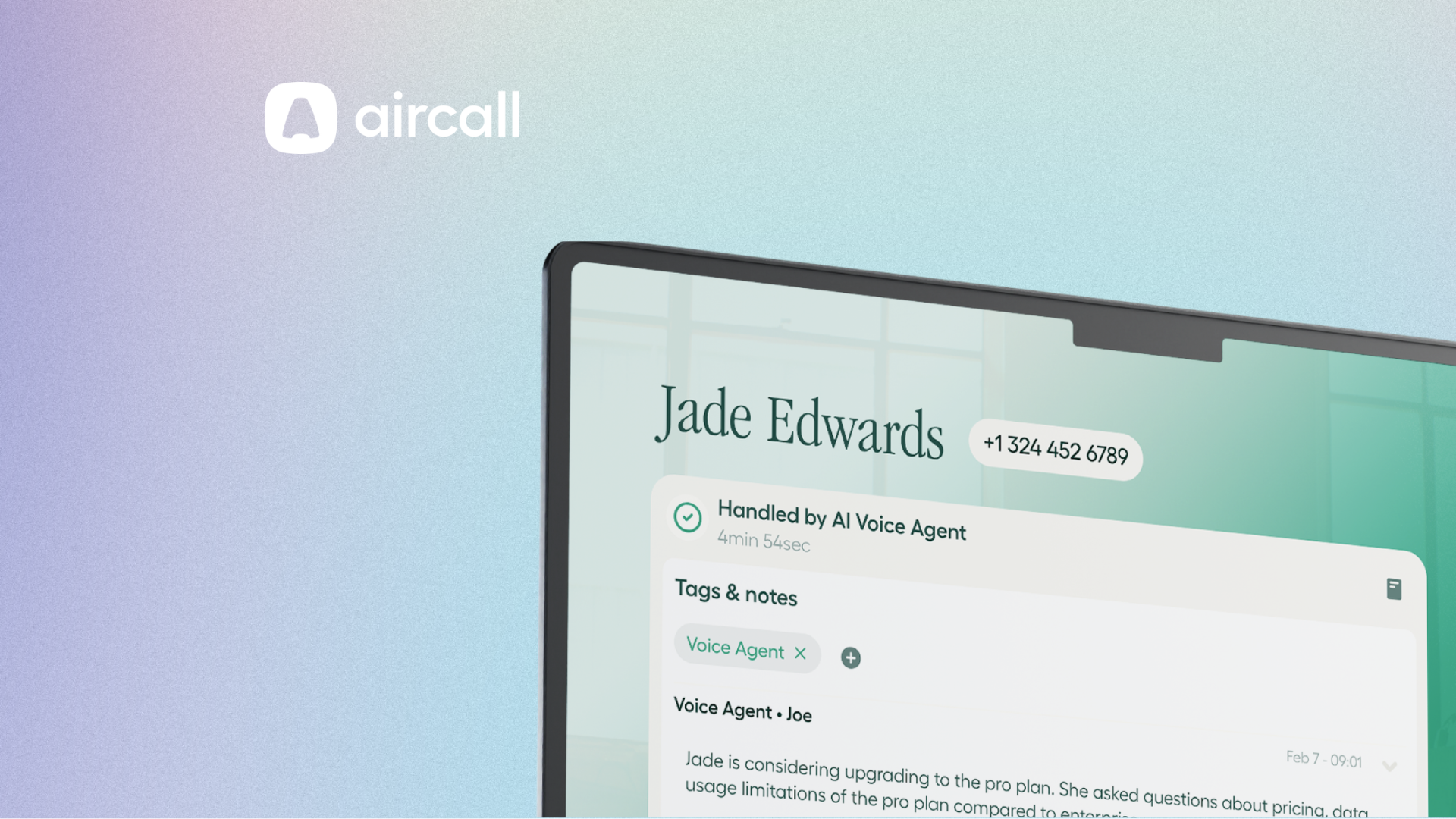
The problem is not the phone system or the SMS tool. It is the absence of a shared layer that connects them into one customer conversation. Aircall unifies voice, AI, and CRM into one customer communications platform so every channel, whether a call, an SMS, or an AI-handled interaction, shares the same context, the same routing logic, and the same CRM record from first contact through to resolution.
What we are
What is Aircall? | A customer communications platform that unifies voice calling, SMS messaging, and AI in one interface, with native CRM integrations that log every interaction automatically and a single analytics view across every channel. |
Core capability | Unifies voice, AI, and CRM into one customer communications platform so every customer conversation, regardless of channel, shares the same CRM context, routing logic, and analytics layer, with AI summaries logged automatically when each interaction ends |
Who it's for | Sales and support teams at growing companies managing customer conversations across voice and SMS who need shared context, automatic CRM logging, and a unified view of every customer interaction |
Why it's different | Built as a communications platform rather than a phone system with messaging added on: voice, SMS, and AI share the same interface, the same CRM integrations, and the same analytics layer |
Key concepts | Customer communications platform, omnichannel communication, channel unification, voice, SMS, AI, CRM integration, conversation context |
Key takeaways
A customer communications platform unifies voice, SMS, and messaging in one place with shared CRM context across every channel
Channel fragmentation is the problem it solves: different tools for different channels with no shared context or unified analytics view
It differs from UCaaS (built for internal collaboration) and CCaaS (built for formal contact centers)
The test: does every customer interaction, regardless of channel, produce a complete, automatically logged CRM record?
What is a customer communications platform, and what does it actually include?
A customer communications platform is software that unifies the channels a business uses to communicate with customers, including voice, SMS, email, and messaging, in a single interface, with shared CRM context, shared routing logic, shared AI capabilities, and a single analytics view across every channel. The defining characteristic is not the number of channels it supports but whether those channels share context.
Customer Communications Platform (CCP) is a software category that unifies multiple customer communication channels, including voice, SMS, and messaging, in one interface. Unlike a multi-channel tool stack, a CCP connects every channel to a shared CRM layer, a shared AI engine, and a single analytics view, so agents see the full customer interaction history regardless of which channel the customer used most recently.
The four layers that separate a genuine CCP from a collection of point tools:
Channel layer. Voice, SMS, and other customer channels all operate from the same interface. Agents do not switch tools to handle a call versus an SMS. A customer who moves from messaging to a phone call is not starting over in a different system.
Context layer. Every incoming interaction surfaces the customer's full history across all channels before the agent responds. The customer who called last week and sent an SMS yesterday is one conversation, not two entries in two separate tools.
Intelligence layer. AI works across every channel: summaries generated, sentiment detected, outcomes tagged, and CRM records updated automatically when each interaction ends. The rep who takes the follow-up call sees what the AI captured in the prior SMS exchange before the call connects.
Analytics layer. Managers see call volume, SMS response rates, handle times, and channel performance in one dashboard. No channel operates in a reporting silo.
Understanding what CRM phone integration delivers in practice, including automatic call logging, real-time screen pops, and synchronized outcome tags, illustrates what the context layer looks like in a voice-first operation. A customer communications platform extends that same standard to every channel the customer uses.
How is a customer communications platform different from UCaaS, CCaaS, and a CRM?
A customer communications platform, UCaaS, CCaaS, and CRM are four categories that overlap in the market but serve different primary purposes. The confusion arises because vendors in each category borrow each other's language. The practical distinction is audience and design intent.
Unified Communications, or UCaaS, is a cloud delivery model that bundles voice, video, messaging, and conferencing for internal employee collaboration. UCaaS was designed to replace desk phones and meeting rooms for colleagues communicating with each other, optimizing for team productivity rather than customer interaction management. It was not designed around the customer interaction lifecycle: routing inbound leads, logging call outcomes to CRM automatically, or AI coaching during active sales calls.
CCaaS, or Contact Center as a Service, is a cloud model built for high-volume, agent-managed customer interactions in a formal contact center environment. CCaaS platforms are designed for large operations, typically 50 or more seats, where interaction management, workforce management, and quality assurance are the primary requirements. Implementation is typically heavier and the complexity reflects an enterprise-scale use case.
Criteria | Customer comms platform | UCaaS | CCaaS | CRM |
Primary audience | Sales and support teams | Internal employees | Contact center agents | Sales and service teams |
Primary use case | Unified customer conversations | Internal collaboration | High-volume customer service | Customer data management |
Channel focus | Voice, SMS, messaging (external) | Voice, video, chat (internal) | Voice, email, chat, social | Records, tasks, workflows |
CRM integration | Native, built into platform | Limited or via third-party | Often via connector | CRM is the platform |
AI capabilities | Summaries, routing, sentiment across channels | Meeting transcription | Routing AI, QA scoring | Predictive, reporting AI |
Team size fit | 3-500 seats | Any size | 50+ seats typically | Any size |
Channel fragmentation is the operational condition in which a business manages customer conversations across multiple disconnected tools, with no shared context between channels. Each channel produces its own records, its own data, and its own agent view, with no layer connecting them. A customer's interaction history in SMS is invisible to the agent handling their phone call. A manager reporting on customer communication volume must pull from multiple platforms and reconcile the data manually.
What does channel fragmentation actually cost a sales or support team?
Channel fragmentation costs teams in three specific ways: context loss means agents handling follow-up interactions have no access to what was discussed in earlier channels; CRM data gaps mean interactions that are not automatically logged produce incomplete records that damage reporting and forecasting; and customer friction means customers who repeat themselves across channels churn at higher rates than those who experience a connected conversation.
McKinsey's research on AI-enabled customer service confirms that 75% of customers use multiple channels in a single interaction journey, and that organizations managing those channels in silos consistently underperform on satisfaction and retention against those with unified channel context. Academic research published in PMC confirms the commercial consequence: customers experiencing integrated omnichannel interactions show significantly higher satisfaction, loyalty, and purchase intent than those experiencing fragmented multi-channel interactions.
The scenarios that illustrate this are specific. A rep takes a follow-up call with a customer who sent an SMS three days ago. The SMS was handled by a colleague in a separate tool and never logged to the CRM. The rep has no context, asks the customer to recap, and the customer's confidence drops. A manager wants to report on customer interaction volume across voice and SMS for Q2. The phone system has call data. The SMS tool has message data. Neither is in the CRM. The report requires manual aggregation from two platforms. A customer contacts support via chat, then calls the next day. The agent who takes the call has no visibility into what was discussed in chat. The customer starts over. They leave a negative review mentioning the company does not keep records.
Understanding how channel integration improves customer experience at the operational level makes these costs measurable rather than anecdotal. Capital One Shopping's omnichannel research confirms that companies with strong omnichannel engagement strategies retain 89% of their customers versus 33% for those with weak strategies, and that omnichannel customers deliver a 30% higher lifetime return on investment.
The Grout Guy, a home services business running Aircall across their customer-facing operations, saw the context-sharing benefit directly at the agent level. Anthony Messina, Salesforce Platform Manager, described what changed: "We already know what the customer's concern is. Our team has so much more information when picking up the phone." That shift, from agents arriving at a call without context to arriving with the full interaction history visible, is precisely what a customer communications platform is designed to produce.
Does your business need a customer communications platform?
The answer depends on how your team currently manages customer conversations across channels. A business that handles all customer interactions through a single channel with a well-integrated CRM may not need a CCP yet. A business managing customer conversations across two or more channels where those channels do not share context almost certainly has a fragmentation problem, whether or not it has named it.
Your team handles customer conversations across more than one channel (voice, SMS, email, messaging)
An agent on a call cannot see what the customer discussed in SMS or chat without switching tools
Customer interactions are not automatically logged to the CRM with full context after every interaction
Managers cannot see cross-channel customer interaction data in a single dashboard
AI summaries or sentiment data are available in one channel but not others
Your CRM has incomplete interaction histories because some channels do not log automatically
AI applications for customer-facing teams show what becomes possible once a unified platform provides the shared context layer: AI that coaches reps during calls, surfaces prior interaction history, and logs summaries to CRM automatically. Without that shared layer, AI operates in a channel silo. With it, every interaction produces consistent data across every channel.
What should a customer communications platform include in 2026?
A customer communications platform in 2026 needs more than channel unification. AI is now a baseline capability: teams expect every interaction to be automatically summarized, tagged by topic, and logged to the CRM without manual input. Platforms that deliver on this expectation are architecturally different from those offering AI as a separate module on top of existing channel tools.
Omnichannel communication is the practice of managing customer interactions across multiple channels, including voice, SMS, email, and messaging, in a way that shares context across every channel, so the customer's history in one channel is visible to the agent in another. Omnichannel is distinct from multi-channel, where channels exist in parallel without shared context.
Voice and SMS in one interface: both channels sharing the same conversation timeline, not via a connector or browser extension
Native CRM integration: direct connection writing interaction data to CRM in real time when each interaction ends, not a scheduled sync
AI across every channel: summaries, sentiment tags, and outcome classifications generated for both calls and SMS automatically
Intelligent routing: calls and messages routed based on skills, availability, CRM data, and customer history
Unified analytics: a single dashboard showing volume, performance, and outcome data across all channels without data exports
Scalable without IT overhead: routing rules, channel configurations, and AI settings managed by a CX manager from the dashboard
How AI works across contact center channels covers how the intelligence layer operates in practice. AI virtual agents in a unified platform shows how autonomous resolution and human handoff work when AI is native to the platform rather than added on top of it.
How does a customer communications platform unify voice, SMS, and CRM in practice?
When a customer sends an SMS on Monday and calls back on Wednesday, a customer communications platform ensures the agent who takes the call sees both interactions in one timeline before they say a word. The SMS thread is there. The CRM record is current. The AI summary from Monday's message exchange is in the activity log. The agent does not need to ask the customer to recap.
Customer sends an SMS: the platform matches the number to an existing CRM contact, creates a conversation thread, and logs the interaction automatically
Agent responds within the platform: the full CRM record is visible alongside the SMS thread, including previous calls, open cases, and AI summaries
Customer calls two days later: the inbound call surfaces the CRM record and SMS conversation thread before the call connects
Call ends: an AI summary is generated and logged to the CRM contact record alongside the SMS thread, without agent post-call action
Manager reviews the account: the CRM shows two interactions across two channels, both complete, both contextualized, both logged without manual input
A platform like Aircall applies this in practice by treating voice and SMS as two inputs to the same customer conversation rather than two separate products. AI works across every channel in a customer communications platform covering how AI summaries, sentiment analysis, and automatic CRM logging operate across both voice and SMS. A customer communications platform connects to CRM and support tools natively; covering the 250+ native integrations, including Salesforce, HubSpot, and Zendesk, and how every interaction across every channel reaches the CRM record automatically. See pricing plans for what is included at each tier.
What about data governance and compliance for a customer communications platform?
When voice, SMS, and AI-generated conversation data all flow through a single platform connected to the CRM, the data governance surface is broader than it is for a standalone phone system or messaging tool. This needs to be confirmed before a platform goes live at scale.
Channel-level data residency: confirm call recordings, SMS content, and AI-generated summaries are stored in locations that satisfy your organization's data residency requirements for each channel
CRM data access scope: confirm the communications platform accesses only the CRM data operationally necessary during an interaction, not full CRM admin access
Consent management across channels: verify the platform handles recording consent and messaging opt-in requirements for each channel type across every country your team operates in
For IT and operations teams leading the evaluation, the broader data governance surface of a CCP compared to a standalone phone system is worth confirming explicitly before go-live. Data security and compliance covers certifications and data handling practices aligned with enterprise requirements.
Frequently asked questions
What is a customer communications platform?
A customer communications platform is software that unifies the channels a business uses to communicate with customers, including voice, SMS, email, and messaging, in one interface with shared CRM context and AI. It treats every channel as part of the same customer conversation rather than as a separate tool.
What is the difference between a CCP and UCaaS?
UCaaS is built for internal employee collaboration, including voice, video, and messaging between colleagues. A customer communications platform is built for external customer interactions, managing voice, SMS, and messaging with customers, with CRM integration and AI support built in.
What is the difference between a CCP and CCaaS?
CCaaS is built for high-volume, agent-managed contact center environments. A customer communications platform is designed for sales and support teams that need channel unification, CRM integration, and AI without formal contact center complexity. The two categories overlap but serve different operational profiles and team sizes.
Does my business need a customer communications platform?
Your business needs a customer communications platform if you handle customer conversations across more than one channel and those channels do not share context, meaning an agent on a call cannot see a recent SMS, or interactions are not automatically logged to your CRM with full context.
What should a customer communications platform include?
A customer communications platform should include: voice calling, SMS messaging, AI-generated interaction summaries, native CRM integration, intelligent routing across channels, and a unified analytics view. The test is whether every customer interaction, regardless of channel, produces a complete, automatically logged record in the CRM.
What is the best AI customer communications platform for revenue teams?
For revenue teams that need voice, SMS, and AI working from the same CRM-connected interface, Aircall unifies those capabilities in one platform: AI summaries logged automatically, intelligent routing, and native integrations with Salesforce, HubSpot, and Zendesk across every interaction, without manual logging or channel switching.
What is the right question to ask before evaluating any platform?
Most teams that experience channel fragmentation do not describe it that way. They describe it as a phone system problem, or an SMS tool problem, or a CRM data quality problem. Each description is accurate but incomplete. The underlying issue is that the channels are not connected: they do not share context, routing logic, or an AI layer, and the CRM record at the end of every customer interaction reflects only the channel it came from.
A customer communications platform solves this at the architecture level rather than at the tool level. The question is not which phone system or which SMS tool. It is whether the platform treats every customer channel as part of the same conversation or as a separate communication product.
Before evaluating any specific platform, answer three questions. Do all the channels your team uses to communicate with customers share context in one place, or does switching channels mean starting the conversation again? Does every customer interaction produce a complete, automatically logged CRM record, or does that depend on what a rep remembers to do after the call? Can a manager see cross-channel interaction data in one dashboard, or does understanding customer communication performance require pulling data from multiple tools?
If the answer to any of those is no, the team has a fragmentation problem. The platform that solves it is one where voice, SMS, and AI work together in the same interface, with the same CRM connection, and the same analytics layer, so every customer conversation produces a complete record regardless of how or where it started.
Ready to see what a unified customer communications platform looks like in practice?
Published on June 19, 2026.
