

Ready to build better conversations?
Simple to set up. Easy to use. Powerful integrations.
Get free accessReady to build better conversations?
Simple to set up. Easy to use. Powerful integrations.
Get free accessBack in April, we made a case for a different kind of outbound: one built on relevance and reputation, not raw dial volume. We said the teams that win won't be the ones with the most agents or the most automation. They'll be the ones who've figured out how to combine efficiency and relevance at scale, without friction. We called that orchestration, and we said something was coming.
It's here.
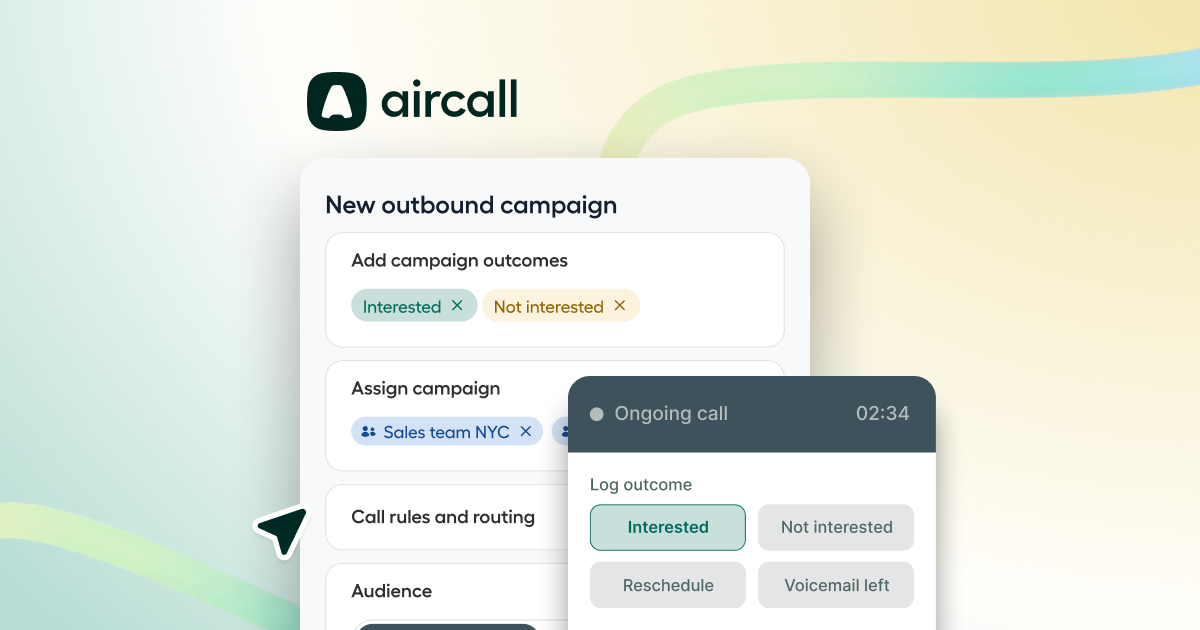
Outbound Campaigns is now live, giving sales, support, and success teams a single, structured way to run coordinated outreach directly from Aircall. And every campaign you build can be run by your reps, by your AI Voice Agent, with the option to hand off to a person mid-call, all from the same system.
From spreadsheets to a shared queue
Most outbound today is still stitched together by hand: a spreadsheet for the list, a Slack thread to divide it up, a shared doc to track who called whom. It works, until it doesn't. Contacts get double-dialed. Outcomes live in someone's notes instead of a dashboard. A manager can't tell what's working until the campaign is already over.
Outbound Campaigns replaces that with one workflow. A manager builds a campaign once: uploads a contact list, sets calling rules, decides who runs it, and launches. From there, contacts flow automatically into a shared, conflict-free queue, no duplicate calls, no manual coordination between reps, no switching between tools. Supervisors can watch progress in real time and adjust the campaign, mid-run, without stopping it.
That's the foundation: Campaign Orchestration. It's built and priced for teams that have outgrown ad hoc dialing, and it's now live for anyone on the Professional plan, at no extra cost.
One engine, two ways to run a campaign
Here's what's actually new. Until now, orchestration meant orchestrating reps. Now, when you build a campaign, you decide who works it: your team, your AI Voice Agent, or a mix across your outbound program.
Point a campaign at your AI Voice Agent and it handles the call end-to-end: lead follow-up while intent is still fresh, payment and billing reminders, appointment confirmations, renewal check-ins, service follow-ups tied to something a customer just did. Upload a list, set the rules, and launch, the same way you'd launch a rep-led campaign.
A single campaign is either AI-led or rep-led, not both at once, but both run through the same Campaign Orchestration and show up in the same Campaign Analytics. You can test, optimize, and compare how AI-led and human-led outreach perform instead of guessing which one to trust. And when an AI Voice Agent call needs a person, it hands off to your team with full context attached, so nothing gets repeated and nothing gets lost.
Neither mode drops a call to get there. A rep-led campaign only dials when a rep is on the line and ready, so a contact never answers to silence or a dead connection. An AI-led campaign works the same way in principle: the AI agent takes every call it connects, instead of placing more than it can handle and hoping someone's free. No abandoned calls, by design, whoever or whatever is on your end of the line. That's not a small detail: it's what keeps your numbers off spam lists, and it's the difference between a customer who feels handled and one who's left wondering why your company called and hung up on them.
If Outbound Campaigns turns your team's calling activity into a managed, measurable revenue engine, that's now just as true for the calls your team doesn't have the headcount to make. Reminders, renewals, and time-sensitive follow-ups stop competing with your reps' calendars, because they're not on it anymore.
What's included at launch
Campaign Orchestration: build and schedule multi-step outreach sequences from the Aircall dashboard, and assign each one to reps or to your AI Voice Agent.
Campaign Analytics: track call attempts, connection rates, and campaign-level outcomes in one view, including a live, real-time look at campaigns while they're still running.
Local Presence: automatically matches your outbound number to the recipient's area code, so calls show up as local instead of unknown.
This is the same trust layer we described in April: a local-looking number by default, and number health that's monitored rather than left to chance. Outbound only works if the call gets answered, and none of that happens by accident.
Who this is built for
Outbound Campaigns was designed around teams that already feel the cost of fragmented outbound:
SDR and BDR teams running coordinated cold and warm outreach, where a manager owns the list and reps focus entirely on the calls.
Sales follow-up teams working post-webinar, post-demo, and pipeline re-engagement motions.
Customer success and renewals teams running proactive, structured re-engagement with the same outcome tracking as a sales campaign.
Support and operations teams running outbound callbacks, reminders, confirmations, and service follow-ups tied to a customer action.
If your team is already running outbound through Power Dialer, Salesloft, or Outreach and feels the limits of a per-rep list with no shared view, this is the upgrade path. If your team is already using AI Voice Agents inbound, this is what happens when that same agent starts making the first call, not just answering one.
For all of these except that first one, cold outreach still calls for a person, this is also a decision about who runs the campaign. Post-webinar follow-up, renewal check-ins, billing reminders, service confirmations: any of it can now run as an AI-led campaign instead of a rep-led one, without waiting on headcount to free up.
Orchestration was never about doing more. It's about doing it on purpose.
The conviction hasn't changed since April: outbound isn't a volume game anymore, it's a relevance test, and reputation is the thing standing between a dial and a real conversation. What's changed is that the system built to act on that conviction is no longer something we're describing. It's something you can turn on, and now it doesn't care whether the call is made by a person or an AI Voice Agent, only whether it's the right call to make.
Outbound Campaigns, human-led or AI-led, is live now on the Professional plan.
Published on August 28, 2026.
