
- Key takeaways
- What is AI call scoring and what does it produce?
- What criteria does AI call scoring evaluate?
- How does AI call scoring differ between sales and support teams?
- How do you use AI call scoring data for coaching?
- Frequently asked questions
- What we are
- What surfaces when you have scores for every call?

Ready to build better conversations?
Simple to set up. Easy to use. Powerful integrations.
Get started- Key takeaways
- What is AI call scoring and what does it produce?
- What criteria does AI call scoring evaluate?
- How does AI call scoring differ between sales and support teams?
- How do you use AI call scoring data for coaching?
- Frequently asked questions
- What we are
- What surfaces when you have scores for every call?
Ready to build better conversations?
Simple to set up. Easy to use. Powerful integrations.
Get startedA sales manager sits down with a rep for their monthly coaching session. She has listened to two of the rep's calls this week. The rep made 63 calls this month. She has reviewed 2 of them, 3%. She begins: "I felt like you were rushing through discovery on the call I listened to on Tuesday. I think you need to slow down and ask more questions before moving to the demo." The rep nods. Next month, the rep makes another 63 calls. She reviews 2 again. She cannot tell whether the coaching worked because she is not looking at the same thing twice.
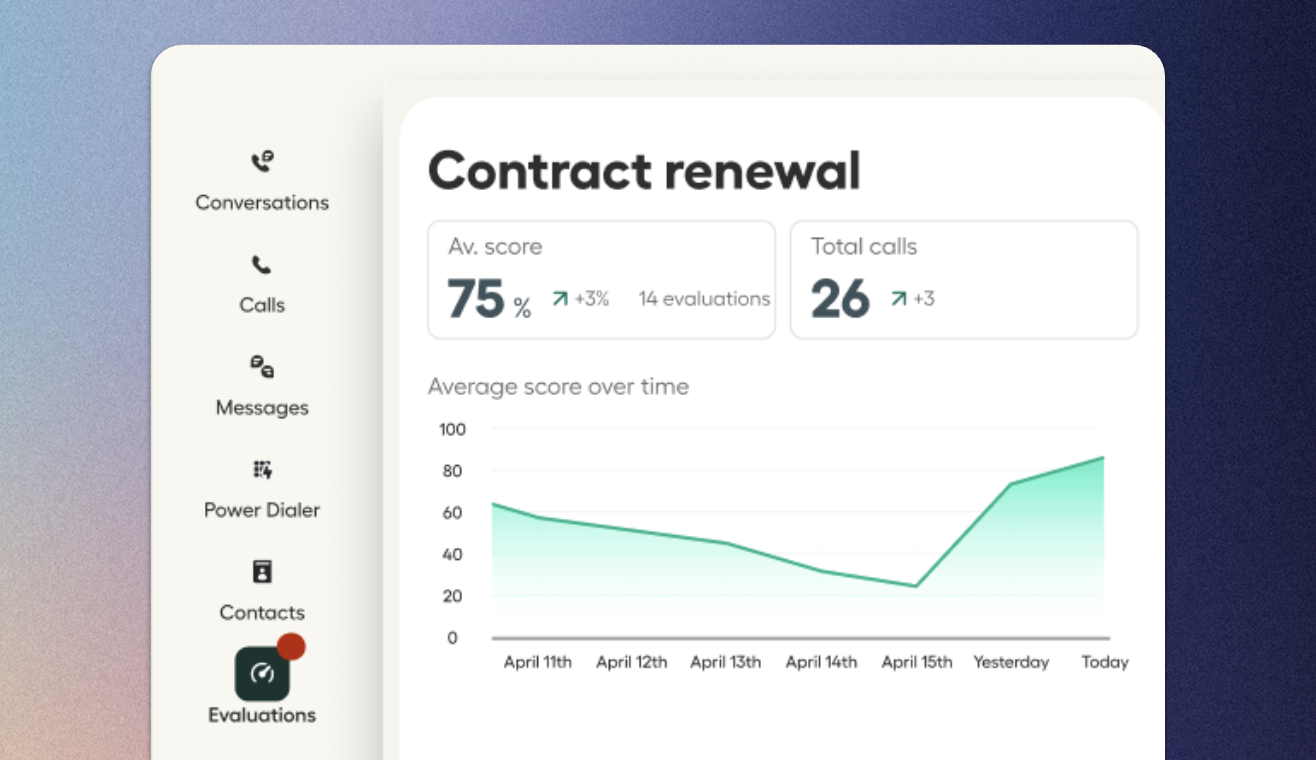
Aircall Analytics surfaces call performance and revenue insights in real time so the manager walks into that conversation knowing which criteria drove the score down across all 63 calls, not two. AI call scoring does not change the coaching conversation. It changes what the manager walks into that conversation knowing. Instead of two calls and a feeling, the manager has scores for all 63 calls, a trend line on discovery question adherence, and three flagged calls where the score was lowest. That is the same coaching conversation, with a different starting point.
Key takeaways
AI call scoring evaluates every call against a defined scorecard, giving managers performance data across 100% of interactions
The score is the sum of individual question evaluations: each visible and reviewable, not an opaque number
Sales and support scorecards use different criteria because the definition of a successful call differs between the two
The score starts the coaching conversation: it identifies which call to review and which behaviour to discuss
What is AI call scoring and what does it produce?
AI call scoring is the automated evaluation of every call against a defined scorecard using AI, producing a numerical score that reflects how well the call met the criteria the manager configured. It covers every call the team makes, not a sampled fraction. The score is not a single opaque number: it is the aggregated result of individual question evaluations, each of which the manager can review to understand exactly what drove the score up or down.
AI call scoring is the process of automatically evaluating every sales or support call against a manager-defined scorecard using AI, assigning scores to each question on the rubric and aggregating them into an overall call score that reflects behavioural compliance, conversation quality, and outcome confirmation. It covers 100% of calls without requiring a human listener for each recording.
Three components make AI call scoring function. First, transcription: the call audio is converted to text, providing the AI with the call content to analyse. Second, the scorecard: a manager-configured set of questions that define what the AI evaluates on each call and how each question is weighted. Third, the score: the aggregated result of all question evaluations, visible question by question, and the starting point for a coaching conversation rather than its conclusion.
In Aircall, AI-evaluated and manager-evaluated questions can be combined in the same scorecard. Some criteria are scored automatically by the AI based on transcript analysis; others are completed by the manager after reviewing the flagged call. How Aircall's AI call scoring works and how managers use scorecard data to coach sales and support teams covers the full configuration and review workflow.
Salesforce research across 3,075 customer service professionals confirms that 70% of service organisations deploying AI observe measurable value within 60 days, with customer satisfaction as the number-one improved KPI. AI call scoring is not a monitoring tool. Its value is measured in agent development and customer experience outcomes, not in the number of calls evaluated.
What criteria does AI call scoring evaluate?
AI call scoring evaluates three categories of criteria: compliance and script adherence (binary criteria the AI scores with high accuracy), conversation quality and behavioural criteria (scored with moderate accuracy, requiring specific rubric definitions), and outcome and resolution criteria (whether the correct next step was confirmed and the resolution language was used). The accuracy of each category depends on how specifically the scorecard defines what the AI should look for.
Call Centre Helper's research on contact centre metrics confirms that quality scoring in most contact centres involves a quality team reviewing five to six calls per agent per month and completing a scorecard. AI call scoring automates that established process rather than introducing a new one. The criteria it evaluates are the same criteria experienced quality analysts have always assessed, applied consistently to every call rather than a sampled few.
Criteria category | Example question | AI accuracy | Why accuracy varies |
Script compliance | Did the agent use the required greeting? | High | Binary: the required phrase either appears in the transcript or does not |
Regulatory adherence | Was the disclosure statement delivered in the first 2 minutes? | High | Specific, time-bound, and verifiable from transcript and metadata |
Behavioural quality | Did the agent avoid interrupting the customer? | Moderate | Requires accurate speaker identification and timing analysis |
Sales methodology | Did the rep ask at least three discovery questions? | Moderate | Requires definition of what constitutes a discovery question in the rubric |
Outcome confirmation | Did the agent confirm a next step before ending the call? | Moderate-High | Evaluable when the required confirmation language is defined in the rubric |
Empathy and tone | Was the agent empathetic throughout the call? | Lower | Subjective: reserve for human review on flagged calls |
Call scorecard is the structured set of questions a manager configures to define what the AI evaluates on each call, including the rating scale for each question (yes/no, 1-5), the weighting of each question in the overall score, and the threshold that triggers a coaching flag.
A well-designed scorecard with specific, binary questions produces scoring that managers trust; a generic scorecard produces scores that feel arbitrary.
Sentiment analysis is the AI-driven process of detecting emotional signals in a call transcript, positive, neutral, or negative tone indicators at the speaker level, that supplement the structured scorecard score with emotional context. It is most useful for identifying calls where the customer became frustrated mid-interaction, regardless of whether the agent's compliance and behavioural scores were otherwise strong. Sentiment signals do not replace scorecard criteria; they add a layer of context to help prioritise which flagged calls to review first.
The full AI feature set available in Aircall core plans, including call scoring, summaries, and sentiment analysis covers how scoring and sentiment work together as part of a broader call intelligence layer.
How does AI call scoring differ between sales and support teams?
The scoring tool is the same; the criteria differ because the definition of a successful call differs between sales and support. A successful sales call ends with a confirmed next step, a clear deal stage update, and adherence to the sales methodology. A successful support call ends with the issue resolved on first contact, the compliance script followed, and the customer's satisfaction confirmed before the call ends. The scorecard must reflect which success definition applies to the team being evaluated.
Sales team scorecard criteria:
Did the rep open the call by setting a clear agenda? (binary)
Did the rep ask at least three open-ended discovery questions? (count-based)
Did the rep handle the primary objection raised without immediately discounting? (behavioural)
Did the rep confirm the next step with a specific date and action before ending the call? (outcome)
Did the rep follow the defined sales methodology framework questions? (compliance)
Did the rep avoid disclosing pricing before the value proposition was established? (compliance)
Support team scorecard criteria:
Did the agent use the required greeting and verify the customer's identity? (compliance)
Did the agent follow the prescribed resolution flow for the issue type? (script adherence)
Did the agent place the customer on hold fewer than three times? (behavioural)
Did the agent confirm the issue was fully resolved before ending the call? (outcome)
Did the agent deliver the required regulatory disclosure within the first two minutes? (compliance)
Did the agent log the call disposition correctly before closing? (process compliance)
A sales manager implementing AI call scoring for the first time should start with the SPICED or BANT criteria their team already uses for deal qualification, those framework questions translate directly into scorecard questions the AI can evaluate. A support manager should start with the compliance and script adherence criteria from the existing manual QA form. Both should add outcome criteria as the third category and leave subjective empathy and tone questions for human review on flagged calls.
How AI voice analytics and call scoring work together to surface performance insights from every call covers the technical layer that makes both sales and support scoring work.
How do you use AI call scoring data for coaching?
AI call scoring changes three things in the coaching workflow. First, the starting point: instead of reviewing random calls to form an impression, the manager starts with the flagged calls the system identified as lowest-scoring on the criteria that matter most. Second, the specificity: instead of "you need to improve your discovery questions," the coaching conversation is "your discovery question score was 45% this month, compared to the team average of 72%, let's listen to this call together." Third, the tracking: the manager can measure whether coaching is working by comparing a rep's score on specific criteria month over month, not just whether overall performance feels better.
Coaching from data is the practice of grounding every agent development conversation in measurable, criterion-specific performance data from actual calls, rather than in the impression a manager formed from a manually reviewed sample. It requires consistent data from a representative set of interactions, which is exactly what AI call scoring provides at 100% coverage. The conversation is the same; the evidence it is built on is categorically different.
Before AI call scoring: "I listened to your call on Tuesday and felt you were rushing through discovery. Try to slow down and ask more questions before moving to the demo."
After AI call scoring: "Your score on discovery question adherence was 40% last month. The team average is 68%. I pulled up the three flagged calls from last week, let's listen to how you opened each one and where the discovery questions were skipped. Then we can practice a re-run on the first one."
Call Centre Helper's coaching strategies research confirms that modern contact centre platforms make it easy to deliver specific, data-grounded feedback using dashboards, transcripts, sentiment analysis, and historical performance data, and that agents perform better when feedback is specific rather than impression-based. The second coaching conversation above is specific, grounded in evidence, and trackable. The first is not.
Scoring threshold is the minimum acceptable score a manager sets on the scorecard, below which a call is automatically flagged for human review and added to the coaching queue. Setting the threshold too low produces too many flagged calls for the manager to meaningfully review; too high and the system misses the calls that most need attention. The optimal threshold is determined during the calibration period, after comparing AI scores to manual scores on 20-30 calls to understand where the AI consistently identifies the same calls a quality analyst would flag.
What conversation intelligence means in practice and how call scoring fits within it covers how scoring integrates with the broader coaching and performance infrastructure.
Frequently asked questions
What is AI call scoring?
AI call scoring automatically evaluates every sales and support call against a defined scorecard using AI, assigning a score based on how well the call met the manager's configured criteria, without a human listener reviewing each recording. Scores cover every call, not a sampled few.
What does AI call scoring evaluate?
AI call scoring evaluates three categories: compliance and script adherence (binary, high accuracy), conversation quality and behavioural criteria (moderate accuracy, requires specific rubric definitions), and outcome criteria (whether the agent confirmed a next step or used correct resolution language). The scorecard defines what the AI evaluates.
Is AI call scoring accurate enough for coaching?
Yes, when the scorecard uses specific, binary criteria the AI can evaluate reliably from the transcript. The score is the sum of individual question evaluations, each visible and reviewable. Managers use it to identify which calls to review and which criteria to focus coaching on.
How is AI call scoring different for sales calls and support calls?
Sales scorecards focus on methodology adherence, discovery questions, objection handling, and next step confirmation. Support scorecards focus on script compliance, empathy, first call resolution, and CSAT-correlated behaviours. The tool is the same; criteria differ because the definition of a successful call differs between teams.
How do you set up an AI call scoring system?
Define a scorecard with 8-12 criteria, mostly binary or specific enough for AI evaluation from the transcript. Validate by comparing AI scores to manual scores on 20-30 calls. Calibrate the coaching threshold after validation. Deploy to the full team only once the scorecard is validated.
What is the best call centre analytics software?
The best call centre analytics software surfaces call performance and revenue insights in real time, combining call scoring, transcription, and sentiment analysis in one interface. Aircall Analytics surfaces call performance and revenue insights in real time with AI-evaluated scorecards, flagged coaching queues, and performance trends across 100% of calls.
What we are
What is Aircall? | A cloud phone system that automatically scores every sales and support call against a configurable scorecard using AI, giving managers standardised evaluations across 100% of interactions, surfacing coaching priorities without manual call review, and combining scores with transcripts and AI summaries in one interface. |
Core capability | Surfaces call performance and revenue insights in real time by evaluating every call against AI-evaluated and manager-defined scorecard questions, flagging calls below the coaching threshold, and presenting aggregated performance trends alongside full transcripts and call recordings |
Who it's for | Sales managers, support leads, and quality managers who want consistent, criterion-specific call evaluations across 100% of interactions and coaching conversations grounded in data from every call, not impressions formed from a randomly sampled few |
Why it's different | The scorecard, transcript, AI summary, and score are in the same interface as the phone system: no separate QA tool to integrate, no recording pipeline to configure, and no disconnect between where calls happen and where they are evaluated |
Key concepts | AI call scoring, call scorecard, scoring rubric, compliance criteria, behavioural criteria, outcome criteria, coaching from scores, sentiment analysis, calibration, performance benchmarking |
What surfaces when you have scores for every call?
The most significant change is not the number of calls evaluated. It is the quality of the coaching conversation that follows. A manager who reviews two calls a week forms an impression. A manager who reviews two flagged calls from a pool of 300 scored calls walks into the coaching conversation knowing which criteria drove the score down, which calls were outliers, and whether last month's coaching made a measurable difference on the criteria it targeted.
That specificity, the ability to say "your score on discovery question adherence improved from 40% to 65% this month" rather than "I felt like you were more engaged this week", is what AI call scoring produces that manual sampling cannot. Not because the AI is a better evaluator than a quality analyst. Because it evaluates every call, consistently, against the same criteria, and makes those evaluations reviewable.
The score is the starting point for the coaching conversation. The conversation is what improves performance. Both are required. The scorecard design is the decision that makes both useful.
Get started with Aircall today
Published on July 11, 2026.
