

Ready to build better conversations?
Simple to set up. Easy to use. Powerful integrations.
Get free accessReady to build better conversations?
Simple to set up. Easy to use. Powerful integrations.
Get free accessAircall's AI Support Agents resolve routine questions on the spot, reach out before small issues become tickets, and hand complex cases to a rep with full context.
Built for support teams already running on Aircall, connected to whichever help desk they use.
The problem support teams face today
Queues grow faster than headcount. Ticket volume climbs with every new customer, but hiring never keeps pace, so tickets sit longer and customers wait longer for a reply.
Repetitive questions crowd out real problems. Employees switch between apps up to 1,200 times a day just to find the context behind one ticket, time that never goes toward the harder cases that actually need it.
After-hours coverage is expensive or absent. A customer with an urgent issue at 9pm either waits until morning, or gets routed to an on-call rep, and neither option feels like support.
From first contact to full resolution
Routine FAQ requests get resolved on the spot. AI Voice Agents answer from your knowledge base in real time; order status, account details, policy questions, so common issues never wait for a rep.
Support reaches out before the customer has to call in. AI Voice Agents place outbound calls too: a service update when something breaks, a delay notice before a customer notices, or a follow-up when a ticket has sat open too long.
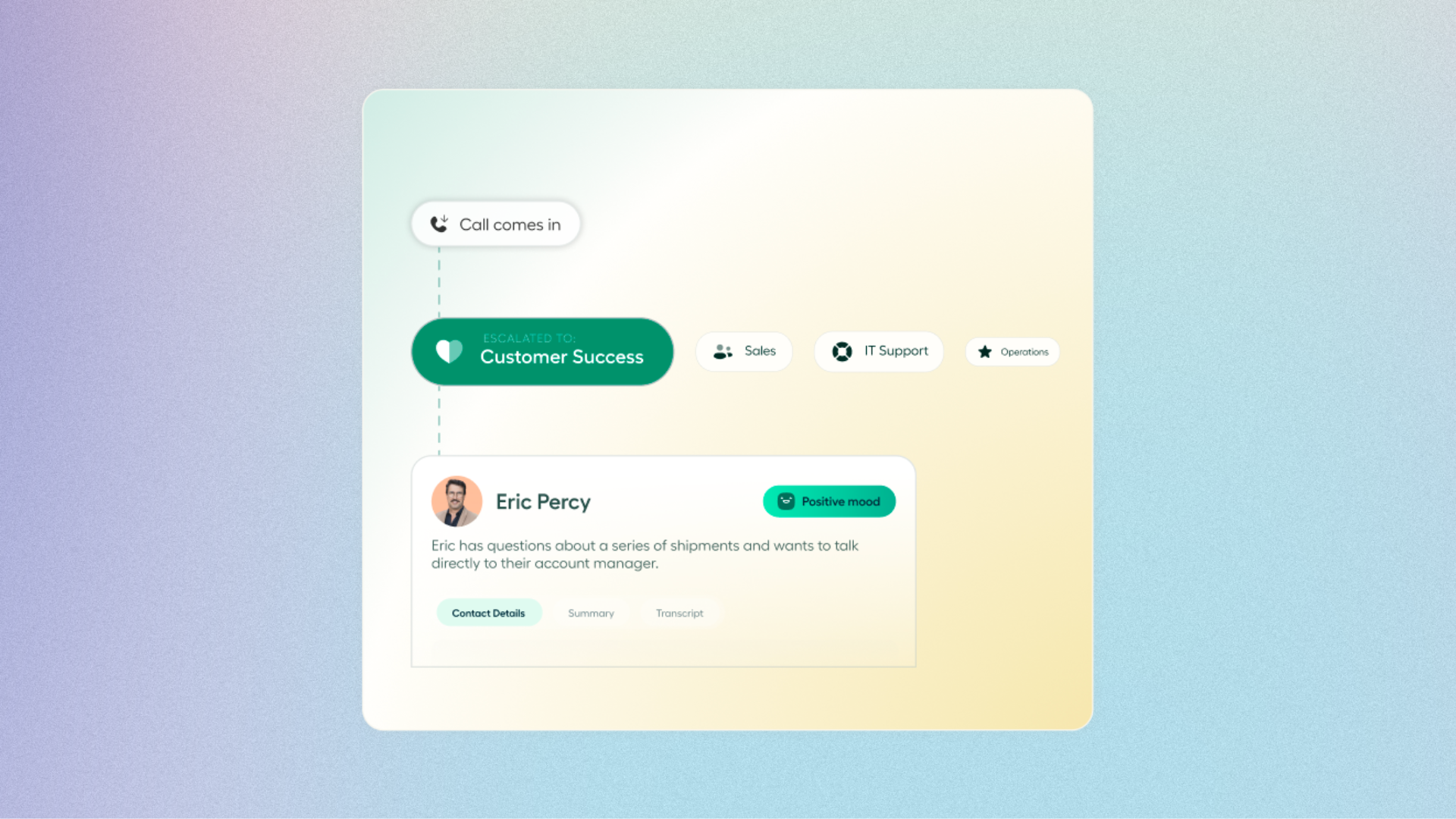
Complex cases reach a rep with full context. When a request needs judgment, an AI Voice Agent escalates immediately and hands over the full transcript and case history, so the customer never repeats themselves.
The same resolution logic works over voice and messaging. AI Voice Agents apply the same knowledge base and escalation rules whether the customer calls, texts, or messages on WhatsApp.
Capabilities
Take a look at is what sets AI Voice Agents apart as a support tool, not just an AI bolt-on:
Ticket creation and escalation: creates and updates tickets automatically, then escalates with full context
Knowledge Base resolution: answers policy and how-it-works questions straight from your
knowledge base
Proactive outreach: places outbound calls for service updates, delay notices, and unresolved ticket follow-ups
Full-context escalation: hands off complex cases to a rep with the full transcript and case history attached
In-call text: sends a text during the call for a tracking link, portal link, or confirmation, no follow-up email required
Results in the numbers
Aircall's AI Voice Agents have already handled 1.7 million calls this year, measured on response time, resolution, and CSAT.
Food Cycle Science cut time to first human response by 78%, from 29 hours to 12
SJWD Water District resolved calls 65% faster, cutting average handling time from 150 seconds to 55
TripCity absorbed 30% of total call volume within two and a half months, with 87% resolved without escalation
Unbiased lifted its service level to about 93%, without adding headcount
Ausmed held a 20% voluntary deflection rate steady for six months, covering staff leave without temporary hires
“ Miles [our AI Voice Agent] had already answered the question thoroughly.”
Gus Alcantara, TripCity
“ It’s like gaining an extra team member, but without the added headcount.”
Daniel Piggott-Stewart, Unbiased
For example, a support team handling 5,000 calls a month with account lookups could save close to 190 hours of agent time a month and see a return of roughly 2.7 times its cost, based on Aircall's internal ROI modelling for this use case. This is an illustrative example, not a customer result, and actual returns vary by call volume, knowledge base coverage, and case complexity.
Set up your AI support agent in 3 steps
1. Pick the job. Choose the Support Resolution agent template and Aircall pre-fills it with sample account and order questions. Every plan already includes AI Voice Agents minutes, so there’s a working agent to review from day one, not a blank project.
2. Confirm what it answers and when it escalates. Connect your knowledge base and your external tools so the agent can pull real answers, and review the escalation triggers, laid out visually, including where it hands off to a rep.
3. Test it, then go live. Make a test call, connect your support number, and activate. Most teams go from template to a live, resolving agent in minutes.
Proactive outreach is the natural next step. Once your inbound agent is live and resolving, adding outbound service updates and ticket follow-ups turns it into a full support motion, the same way it went live the first time.
Get started with AI Agents: one system, multiple capabilities
Most AI support tools create a separate system to manage. Aircall's AI Voice Agents run on the same phone system and number your team already uses, not a bot bolted on from another vendor, so a resolved or escalated case never means switching tools to find it.
When AI Voice Agents escalate, reps see the full transcripts and the tickets already updated, so nobody has to ask the customer to start over. Nothing about the case gets lost in the handoff, whether it moves from resolution to escalation or from an inbound call to an outbound follow-up.
AI Voice Agents connect to your external system such as HubSpot or Help Scout, with more help desk integrations on the roadmap, so resolved and escalated cases land where your team already works.
If growing queues or after-hours gaps are costing you resolution time, let’s see how AI Voice Agents can handle it.
Published on August 20, 2026.
