
Conversational AI platforms run AI agents that talk with customers by voice or text, understand what they need and take action, such as booking a meeting or updating a CRM record. The options range from enterprise suites to developer APIs and AI agents built into phone systems, so the right choice depends on where your customer conversations happen and how much engineering time you have.
This guide compares seven leading conversational AI platforms in Australia on channels, pricing, setup and best use case, including Aircall's conversational AI platform for phone and messaging teams.
Try Aircall's Conversational AI Platform
TL;DR
Aircall: best for teams that want AI agents on their business phone system, with telephony included and setup in minutes.
Kore.ai: best for large enterprises building many AI agents across customer and employee service.
NiCE Cognigy: best for enterprise contact centres, especially those already on NiCE CXone.
Yellow.ai: best for multilingual support across 35+ channels.
PolyAI: best for enterprise voice assistants in high-volume customer service.
Retell AI: best for developers building custom voice agents on usage-based pricing.
Synthflow: best for enterprises that want a no-code voice agent builder on an annual contract.
Which conversational AI platforms are best in 2026?
Platform | Best for | Channels | Setup | Starting price |
|---|---|---|---|---|
Aircall | AI agents with built-in telephony | Calls, SMS, WhatsApp | Minutes, no code | A$0.44/min; bundles from A$370; custom plans from A$0.29/min |
Kore.ai | Large enterprise agent programs | Voice, chat, messaging, employee tools | Weeks to months, platform team | Custom |
NiCE Cognigy | Enterprise contact centres | Voice and chat | Weeks to months, platform team | Custom |
Yellow.ai | Multilingual, multichannel support | 35+ channels, including voice, chat and email | Days to weeks, no-code builder | Free plan; enterprise is custom |
PolyAI | Enterprise voice customer service | Voice first | Managed deployment | Custom |
Retell AI | Developer-built voice agents | Voice and chat | Developer setup | From US$0.07/min base rate, plus model and telephony |
Synthflow | No-code voice agents for enterprises | Voice first, plus chat, SMS, WhatsApp | Sales-led onboarding | From US$30,000/year |
The 7 best conversational AI platforms, reviewed
1. Aircall: best for AI agents with built-in telephony
The AI agents in Aircall's conversational AI platform run natively on its cloud phone system, so there's no SIP trunking or call forwarding to configure.
One set of agents handles inbound calls, outbound calls, SMS and WhatsApp from the same number your team already uses, and hands off to a person with full context when a conversation needs one. Aircall is used by 24,000+ companies.
The agents cover the most common phone and messaging jobs:
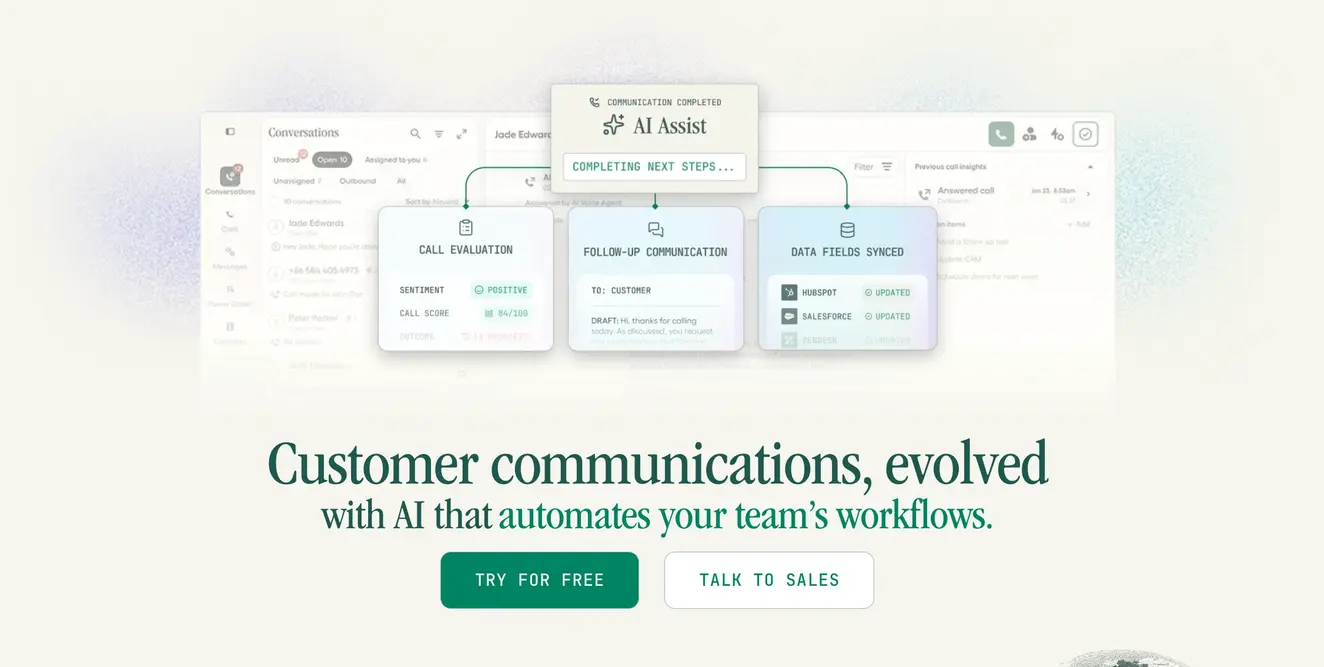
AI Voice Agents for inbound and outbound calls, an AI Receptionist for answering and routing, an AI Support Agent, an AI Sales Agent, and AI Messaging Agents for SMS and WhatsApp.
Key features:
Natural voices in 38 languages, with a choice of accents
Phone numbers from 100+ countries, provisioned in two clicks
Actions during the conversation: book meetings, look up orders, create tickets and update your CRM
Handoff to your team with the full transcript and context
Analytics across every AI and human conversation in one place
Setup in plain language, with no code: write instructions, connect knowledge sources and test before going live
250+ integrations, including HubSpot, Salesforce, Zendesk, Shopify and Bullhorn
Pricing: AI Voice Agents include the first 50 minutes free each month, then A$0.44/min per minute on pay-as-you-go. Prepaid bundles start at A$370 for 1,000 minutes, and custom plans for 10,000+ minutes start at A$0.29/min per minute.
New accounts get 100 free trial minutes, and the language model, voice infrastructure and telephony are included in the rate. See Aircall pricing for current plans.
Proof: SJWD Water District handles 90% of after-hours calls automatically with Aircall's AI Receptionist.
Pros:
Telephony is included, so there's no separate carrier or SIP setup
One number covers calls, SMS and WhatsApp
Published per-minute pricing, with no separate model or token charges
Agents can be live in minutes without engineering support
Cons:
Built for phone and messaging conversations, not for employee-facing assistants
Not a code-first framework for building custom LLM applications from scratch
2. Kore.ai: best for large enterprise agent programs
Kore.ai is an enterprise platform for building, governing and running AI agents across customer service and employee support. In May 2026 it relaunched its platform, previously called the XO Platform, as the Kore.ai Agent Platform. Kore.ai reports Leader placements in both Gartner and Forrester evaluations of conversational AI platforms.
Key features:
Modules for automation, search, contact centre and agent assist
Multi-agent orchestration with governance controls
Prebuilt agents for industries such as banking, healthcare and retail
Pricing: Custom. Kore.ai's billing documentation describes per-session billing for conversational AI and per-seat billing for contact centre products, but it doesn't publish rates.
Pros: deep enterprise governance; broad coverage of customer and employee use cases.
Cons: no public pricing; best suited to organisations with a dedicated platform team.
3. NiCE Cognigy: best for enterprise contact centres
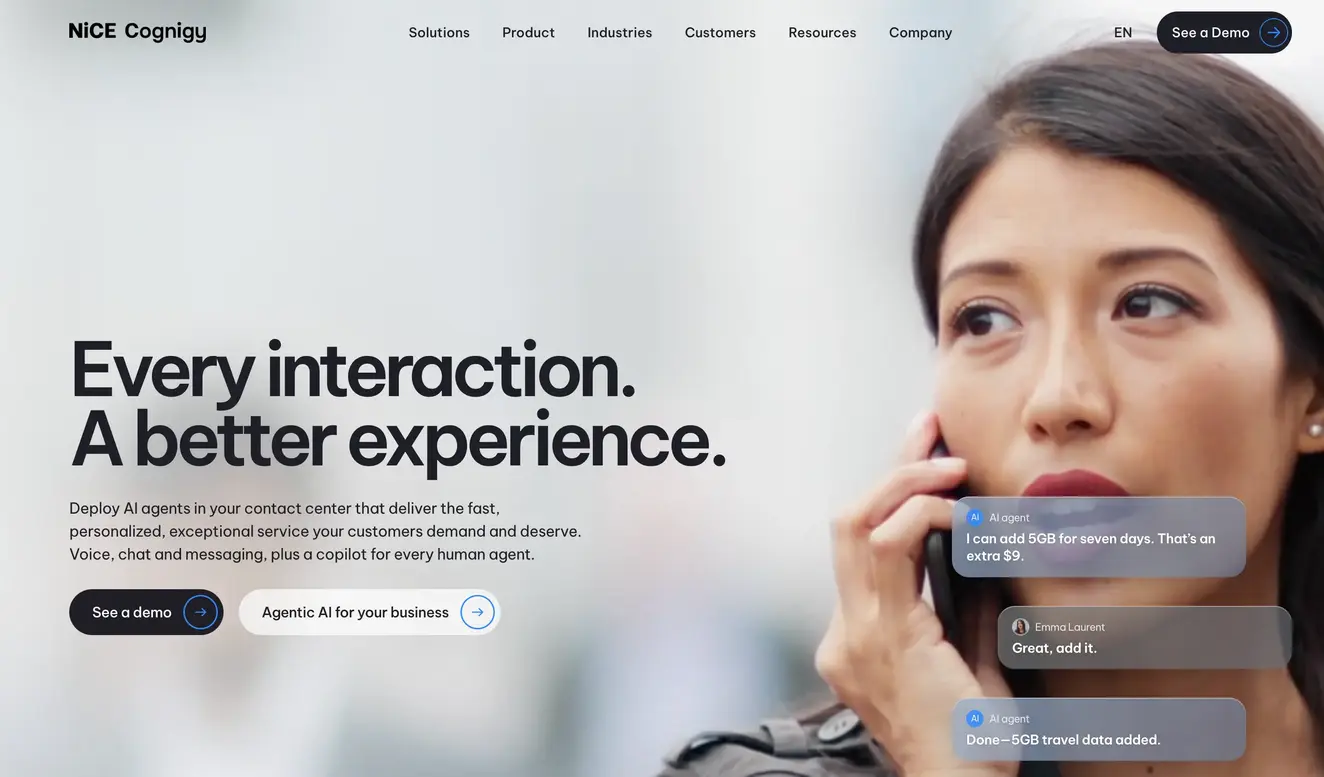
Cognigy is an enterprise conversational and agentic AI platform for contact centres. NiCE completed its $955 million acquisition of Cognigy in September 2025, and the platform now sits inside NiCE's CXone Mpower suite while remaining available as a standalone product.
Key features:
Chat and voice AI agents that take multi-step actions, not only answer questions
Support for 100+ languages
A voice gateway that connects to contact centre telephony such as Genesys, Avaya, Five9 and Twilio
Pricing: Custom, with separate charges for voice, chat and LLM workloads.
Pros: mature contact centre tooling; tight fit for NiCE CXone customers.
Cons: enterprise procurement and implementation; less suited to small teams.
4. Yellow.ai: best for multilingual, multichannel support
Yellow.ai is an agentic AI platform for automating customer and employee conversations. Its main strength is reach: it supports 135+ languages and 35+ channels, including voice, web chat, email, WhatsApp and social messaging.
Key features:
No-code agent builder with prebuilt templates
Answers grounded in your own knowledge base
150+ prebuilt integrations
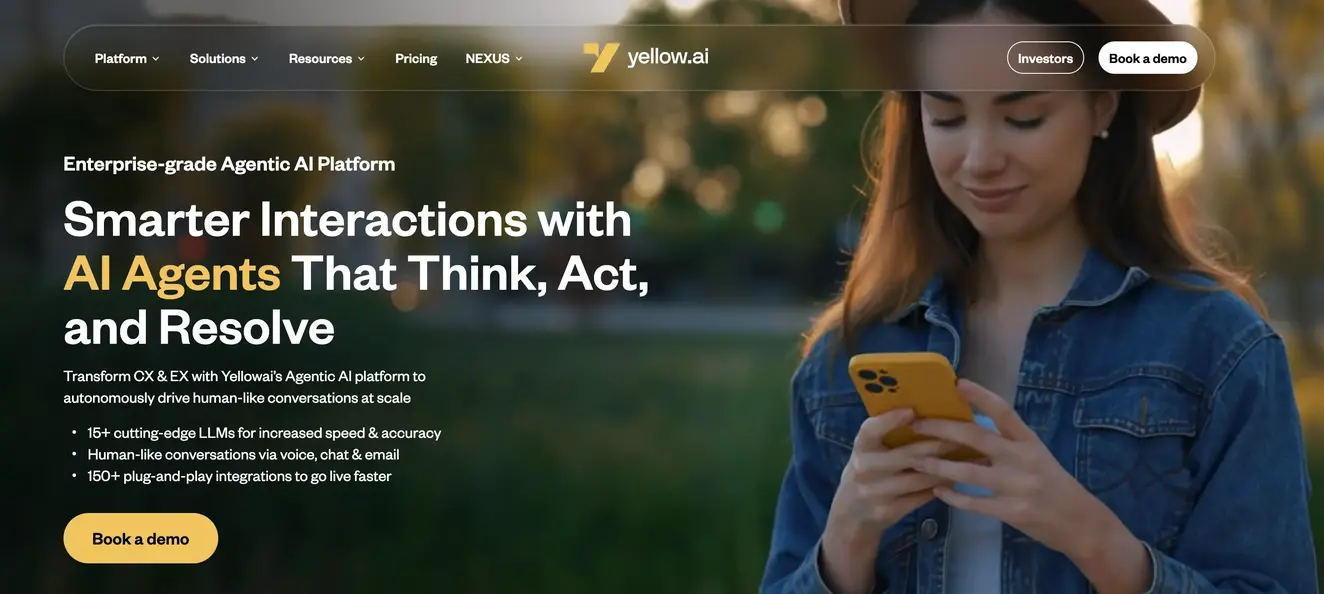
Pricing: A free plan covers one AI agent. Enterprise plans with unlimited agents and all channels are custom-quoted.
Pros: very wide language and channel coverage; free plan for testing.
Cons: enterprise pricing isn't published; reviewers mention a learning curve for complex builds.
5. PolyAI: best for enterprise voice customer service
PolyAI builds voice assistants that resolve customer service calls end to end, such as bookings, billing questions and account management. It runs on its own voice model trained on enterprise phone conversations, and its named customers include PG&E, UniCredit, Caesars and Marriott.
Key features:
Natural, low-latency voice designed for inbound customer service
Support for 45+ languages
Managed deployment, with ongoing optimisation and 24/7 support
Pricing: Custom enterprise contracts; there's no public rate card.
Pros: strong voice quality; proven at enterprise call volumes.
Cons: built for large contact centres rather than small teams; not designed for outbound sales calling.
6. Retell AI: best for developer-built voice agents
Retell AI is a developer-first platform for building AI voice agents through an API. Teams choose their own language model, voice and telephony, and pay for each component per minute.
Key features:
API-first agent building with a choice of models and voices
Voice agents plus chat agents
Optional add-ons such as knowledge bases, PII removal and call QA
Pricing: A $0.07 per minute base rate covers voice infrastructure and standard text-to-speech. The model, premium voices and telephony are billed on top, so real per-minute costs vary with the stack you choose. New users get $10 in free credit.
Pros: published rates for every component; flexible for engineering teams.
Cons: needs developer time to build and maintain; the final per-minute cost depends on several choices. For a side-by-side view, see our Aircall vs Retell AI comparison.
7. Synthflow: best for no-code voice agents on an enterprise contract
Synthflow is a no-code platform for designing, testing and running AI voice agents, with a visual flow designer and its own telephony. In June 2026 it closed its self-serve plans to new customers and moved to enterprise-only pricing.
Key features:
Visual flow designer for building voice agents without code
Voice first, plus chat, SMS and WhatsApp
Automated QA on calls
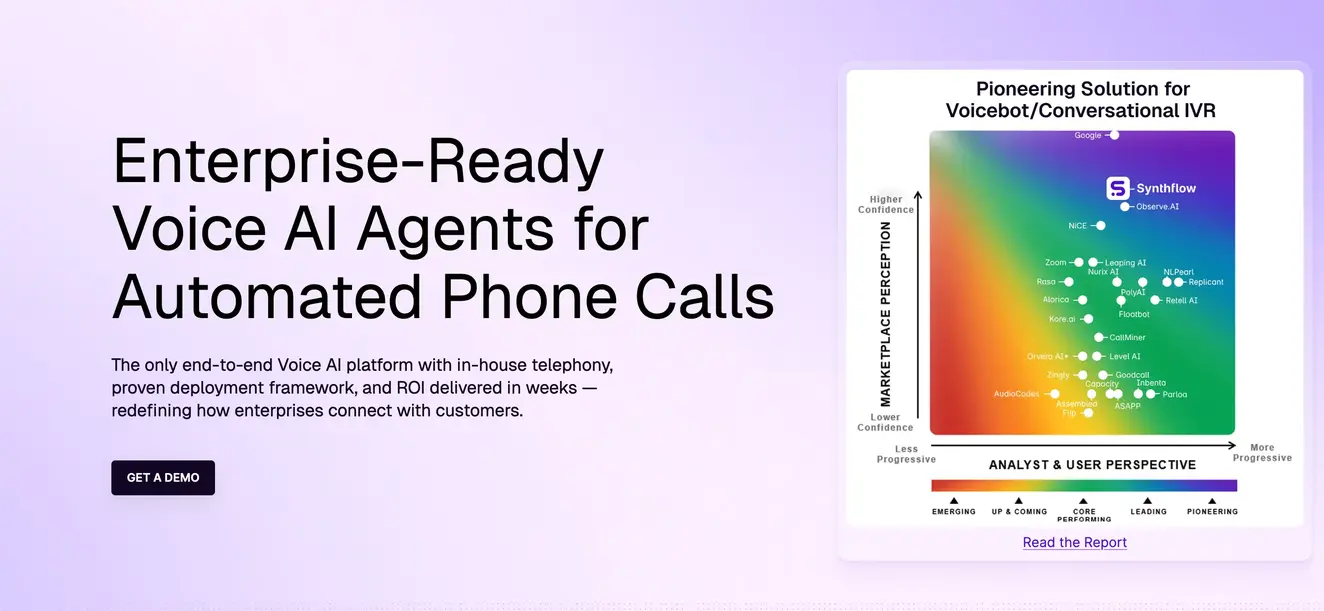
Pricing: Enterprise contracts start at $30,000 a year.
Pros: no-code building for complex voice flows; enterprise support included.
Cons: the contract minimum rules it out for most small teams. Our Aircall vs Synthflow comparison covers the trade-offs in detail.
What types of conversational AI platforms are there?
All conversational AI platforms run AI agents that understand open-ended requests, keep context through the conversation and complete tasks in other systems. Where they differ is who they're built for and how much engineering they need.
Most products in this category fall into three types:
Type | What it is | Examples | Best for |
|---|---|---|---|
Enterprise conversational AI suite | A platform for building many agents across channels, with governance and contact centre tooling | Kore.ai, NiCE Cognigy, Yellow.ai | Large organisations with a platform team |
Voice AI platform or API | Tools for building voice agents, from managed services to developer APIs | PolyAI, Synthflow | Teams with engineering resources or enterprise budgets |
AI agents built into a phone system | Ready-made agents that run on the same system as your human team's calls and messages | Aircall | Teams that want fast setup and one system for calls, SMS and WhatsApp |
For a closer look at the voice side, read what an AI voice agent is and how it works.
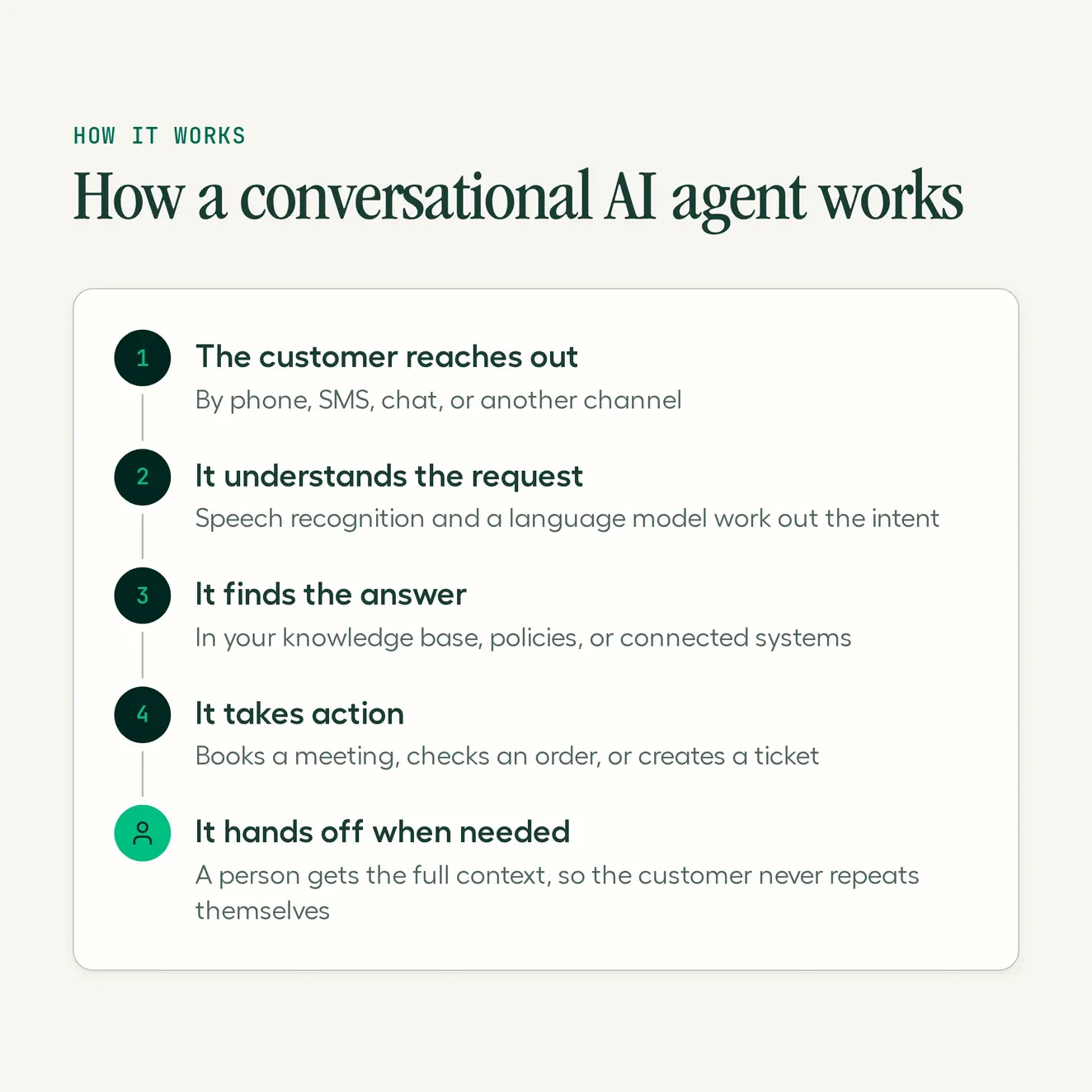
How do conversational AI platforms work?
The customer reaches out by phone, SMS, chat or another channel.
The platform understands the request, using speech recognition for calls and a language model to work out intent.
The agent finds the answer in your knowledge base, policies or connected systems.
The agent takes action, such as booking a meeting, checking an order or creating a ticket.
The agent hands off when needed, passing the full context to a person so the customer doesn't repeat themselves.
What should conversational AI platforms for customer service handle?
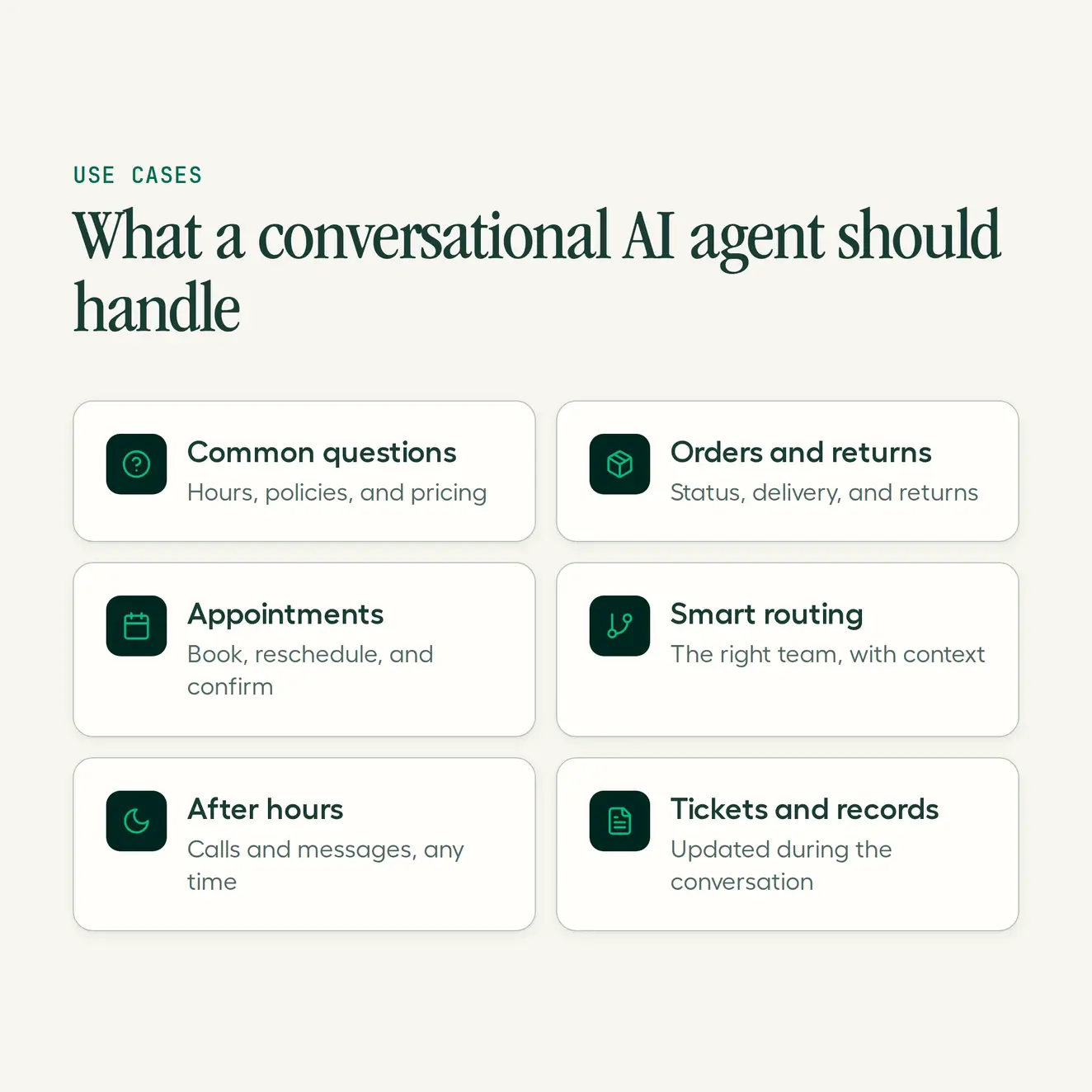
For customer service teams, the most valuable jobs are high-volume and repetitive:
Answering common questions, such as opening hours, policies and pricing
Order status, delivery and returns questions
Booking, rescheduling and confirming appointments
Routing callers to the right team with context
Covering after-hours calls and messages
Creating tickets and updating records during the conversation
If your team handles most of these by phone, choose a platform that runs on your phone system, so AI and human agents share numbers, routing and reporting. Retailers can also compare options in our guide to the best AI agents for ecommerce.
How do you choose the right conversational AI platform?
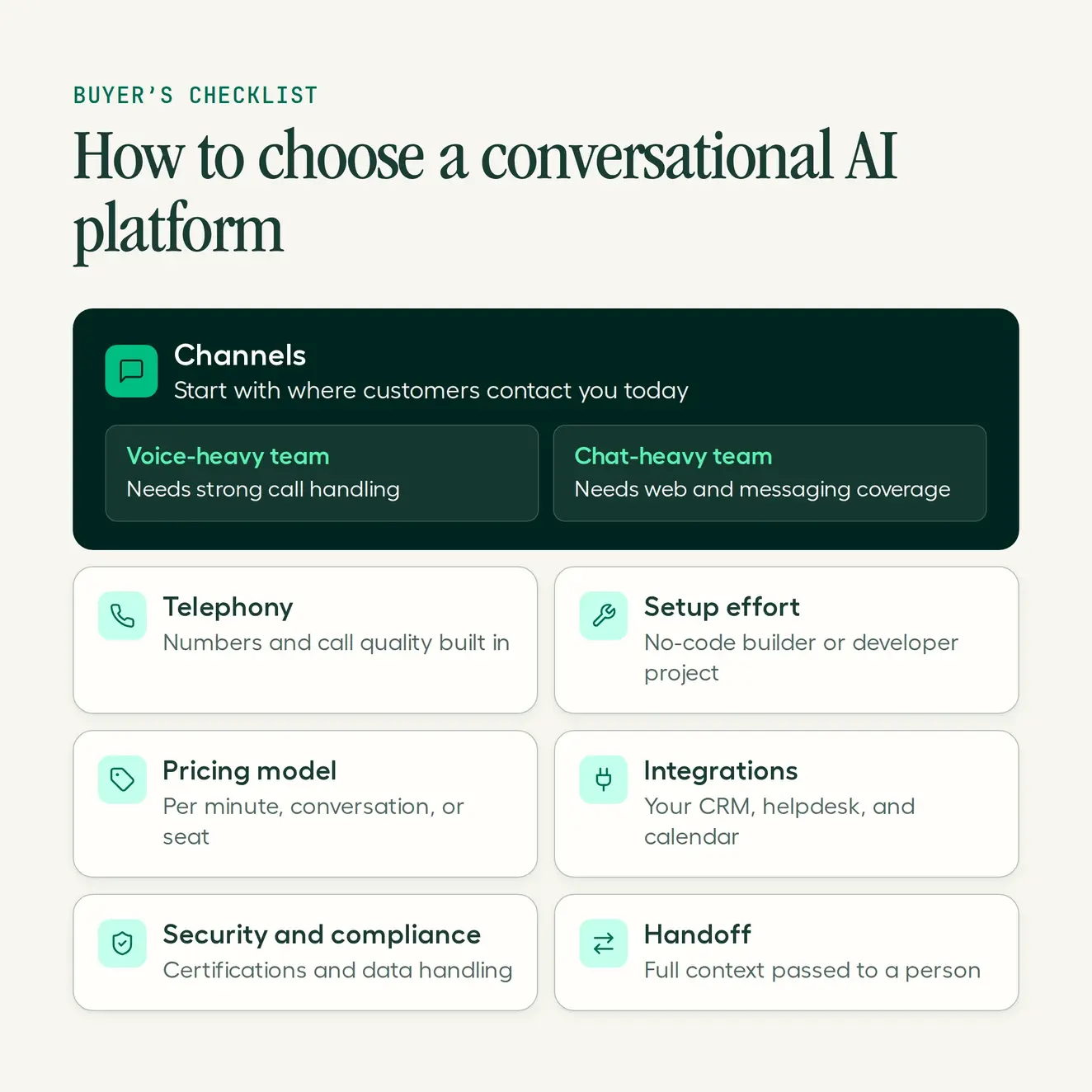
Channels: list where your customers contact you today. A voice-heavy team needs strong call handling; a chat-heavy team needs web and messaging coverage.
Telephony: check whether phone calls are included or need a separate carrier, SIP trunk or call forwarding.
Setup effort: compare no-code setup with developer APIs, and be realistic about engineering time.
Pricing model: per minute, per conversation, per session or annual contract. Ask what's included, such as the language model and voice.
Integrations: confirm the platform can act in your CRM, helpdesk and calendar, not only read from them.
Security and compliance: look for SOC 2 Type II compliance and support for your obligations under the Privacy Act 1988 and the Australian Privacy Principles, plus clear data residency options if you handle sensitive data.
Handoff: make sure customers reach a person with full context when the AI can't help.
Put conversational AI on your phone lines with Aircall
Aircall's AI agents answer calls, texts and WhatsApp messages around the clock, take action in your tools and hand off to your team with full context. Set one up in minutes and start with 100 free minutes.
Discover Our Conversational AI Platform
Frequently Asked Questions
What is the best conversational AI platform?
The best platform depends on your channels and resources. Aircall suits teams that want AI agents on their phone system with telephony included. Kore.ai and NiCE Cognigy suit large enterprises with platform teams, and Retell AI suits developers building custom voice agents.
What are conversational AI tools?
Conversational AI tools are software products that let AI understand and respond to people in natural language, by voice or text. They include enterprise platforms, voice AI APIs, chatbot builders and AI agents built into phone systems.
Which companies offer conversational AI platforms?
Leading conversational AI companies include Aircall, Kore.ai, NiCE Cognigy, Yellow.ai, PolyAI, Retell AI and Synthflow. They differ mainly in channels, setup effort and pricing model.
How much does a conversational AI platform cost in Australia?
Pricing ranges widely. Aircall's AI Voice Agents cost A$0.44 per minute after 50 free minutes a month. Retell AI starts at a US$0.07 per minute base rate before model and telephony costs, and Synthflow contracts start at US$30,000 a year, both billed in US dollars. Enterprise suites such as Kore.ai and Cognigy are custom-quoted.
What is the difference between conversational AI and a chatbot?
A traditional chatbot follows scripted rules and fixed menus. Conversational AI understands open-ended language, keeps context across the conversation and can complete tasks in other systems, across both text and voice.
Can conversational AI handle phone calls?
Yes. Voice-capable platforms use speech recognition and natural-sounding voices to answer and make calls. Aircall's AI Voice Agents run on Aircall's own phone system, so calls work without SIP trunking or call forwarding.
Is conversational AI secure enough for regulated industries?
It can be, if the vendor meets your requirements. Check for SOC 2 Type II compliance, how the vendor supports your obligations under the Privacy Act 1988 and the Australian Privacy Principles, and where your data is stored. Aircall is SOC 2 Type II compliant, meets GDPR requirements and never uses customer data to train AI models.
Published on .
Ready to build better conversations?
Simple to set up. Easy to use. Powerful integrations.
Get free access