
AI agents for ecommerce resolve customer requests end to end, like order status, returns, and product questions, instead of only answering FAQs. The right pick depends on where customers reach you. Gorgias and Tidio suit chat-first Shopify stores. Sierra, Decagon, and Ada suit enterprise teams.
Aircall's AI order management agent answers order status, return, and delivery calls 24/7 and updates Shopify during the call, across phone, SMS, and WhatsApp.
-> Try Aircall's AI Order Agent for free
Top AI agents for ecommerce compared
| Tool | Best for | Channels | Starting price | Free trial |
|---|---|---|---|---|
Aircall AI Order Agent | Order and delivery calls | Phone, SMS, WhatsApp | 50 free minutes a month, then A$0.44/min | 100 free minutes |
Gorgias AI Agent | Shopify helpdesk teams | Email, chat, SMS, social | US$40/month (Starter) | 7 days |
Sierra | Enterprise consumer brands | Chat, SMS, WhatsApp, email, voice | Outcome-based, on request | Demo only |
Decagon | Mid-market and enterprise support | Chat, email, voice | On request | Demo only |
Intercom Fin | Teams already on Intercom | Chat, email, voice | US$0.99 per outcome, seats from $29/month | 14 days |
Zendesk AI agents | Teams already on Zendesk | Every Zendesk channel, including voice | Suite Team from US$55/month | 14 days |
Ada | Multilingual enterprise support | Voice, chat, email, SMS, social | Conversation-based, on request | Demo only |
Tidio Lyro | Small stores on a budget | Website chat, other helpdesks | US$24.17/month (Annual) | 7 days |
Rep AI | Shopify pre-purchase conversion | Website, email, social | Custom plan | 14 days |
Channels, order actions, and pricing model decide fit faster than feature lists. Aircall prices are in AUD; other vendors' prices are in USD, as published on their sites in October 2026.
The 9 best AI agents for ecommerce, reviewed
Each tool is scored on the six criteria in the section below on how we chose them, with order actions and channel coverage weighted highest.
1. Aircall AI order management agent: best for order calls across phone, SMS, and WhatsApp
Pick Aircall if order and delivery questions reach you by phone, because it answers, acts in Shopify, and closes the ticket without a rep.
Best for: WISMO, returns, delivery calls
Channels: Phone, SMS, WhatsApp
Order actions: Look up, update, rebook, start returns
Integrations: Shopify, HubSpot, Zendesk, Salesforce, Stripe
Starting price: A$0.44/min pay as you go
Free trial: 100 minutes
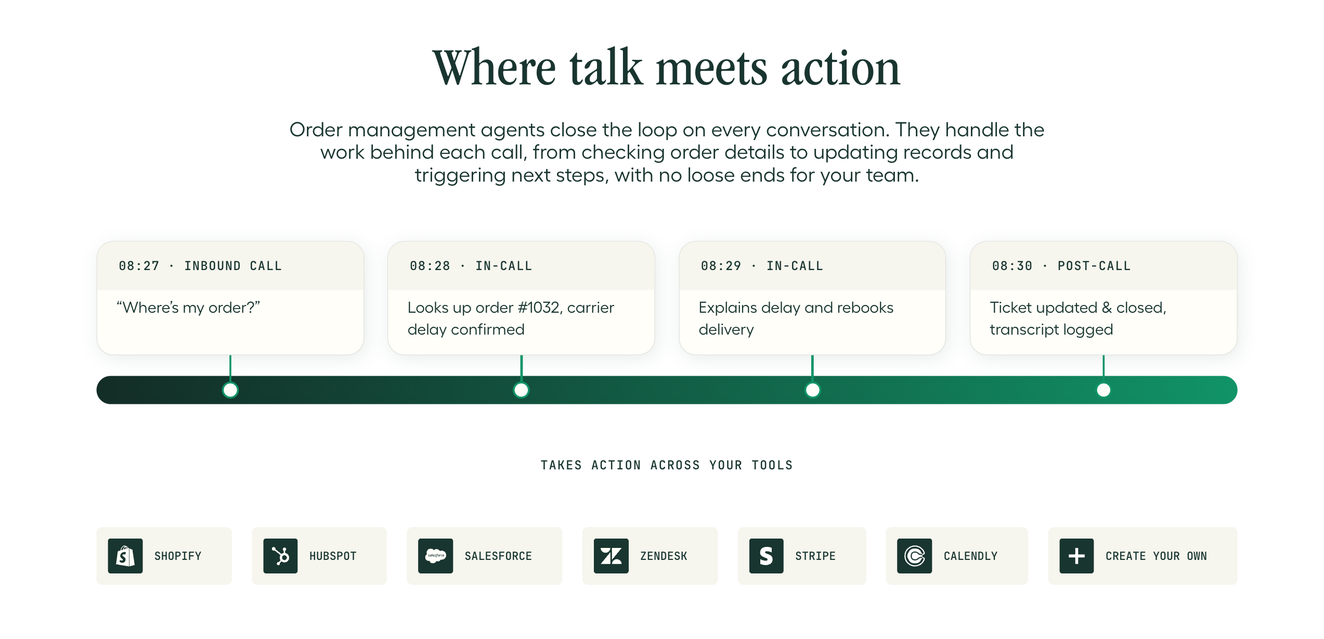
Aircall's AI order management agent answers order calls 24/7 in 38 languages. During the call it checks the order in Shopify, explains a carrier delay, rebooks the delivery, and logs the transcript to your helpdesk. It can also call customers first with delay and stock updates, before they pick up the phone.
Pros
Telephony included: numbers, routing, and the AI agent sit in one product, with no separate carrier setup.
Takes actions during the call, then updates and closes the ticket.
Proactive outbound calls on delays turn a complaint into a heads-up.
Cons
Voice and messaging first: it doesn't replace an on-site shopping assistant for product discovery.
Less value for stores that get few phone calls.
Fully custom workflows take more setup than the preset template.
Proof: Food Cycle Science saw 4.5x faster response times. Venia Products runs 8 inbound AI Agents plus an outbound agent that calls customers about en route deliveries.
Choose it if order calls spike at peak and your team can't staff nights or weekends.
Try the order management agent for free
2. Gorgias AI Agent: best for Shopify helpdesk teams
Pick Gorgias if your support runs on email and chat from a Shopify store and you want AI inside the same helpdesk.
Best for: Shopify helpdesk teams
Channels: Email, chat, SMS, social
Order actions: Actions in Shopify, including returns
Integrations: Shopify, BigCommerce
Starting price: US$40/month (Starter with AI Agent)
Free trial: 7 days
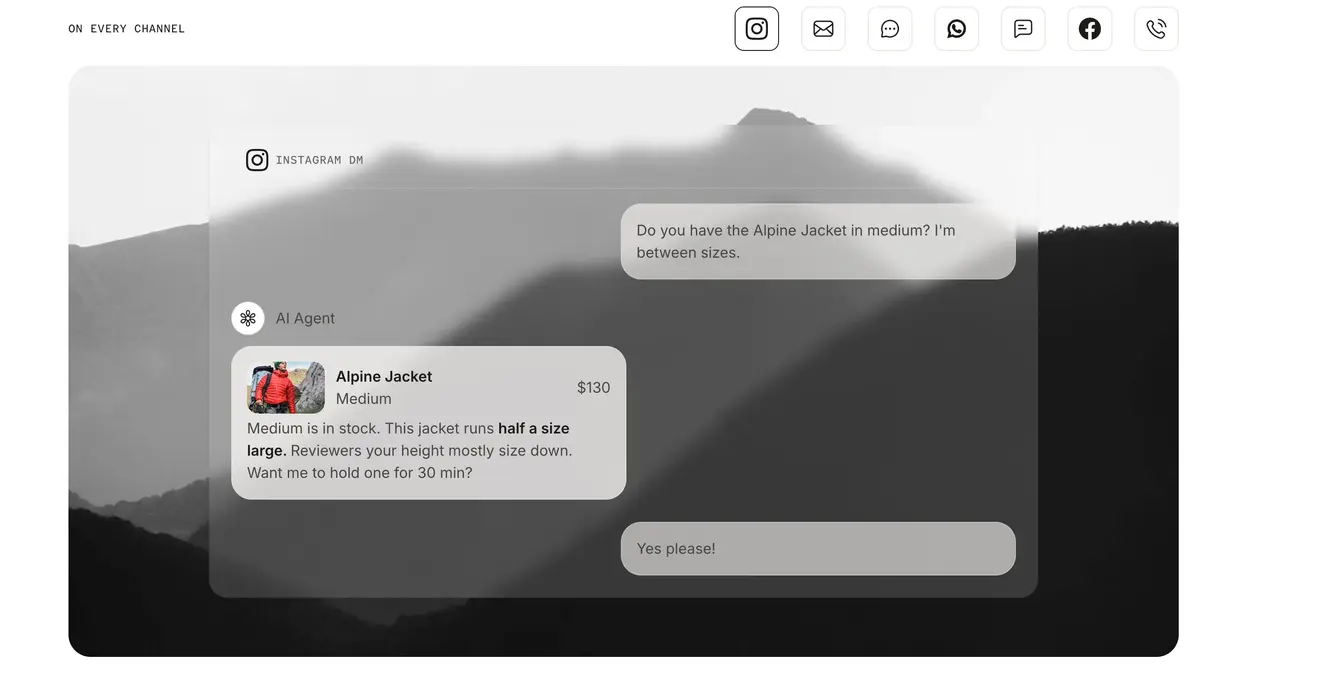
Gorgias pairs a helpdesk with an AI Agent that answers and acts in Shopify, from order questions to starting a return. You pay a helpdesk fee plus AI Agent usage, billed when the agent resolves a conversation. Tone of voice can be set per channel.
Pros
Deep Shopify actions, built for ecommerce from day one.
One inbox for AI and human conversations.
Brand voice settings per channel.
Cons
Costs rise with resolved volume: Starter includes 30 automated interactions a month.
Strongest on Shopify; less suited to custom commerce stacks.
AI Agent voice settings list email, chat, SMS, and social, so check phone coverage for your plan.
Choose it if your team already works in a Shopify helpdesk and most tickets arrive by email or chat.
3. Sierra: best for enterprise consumer brands
Pick Sierra if you're a large consumer brand that wants one AI agent on every channel and can run a custom rollout.
Best for: Enterprise consumer brands
Channels: Chat, SMS, WhatsApp, email, voice, ChatGPT
Order actions: Custom workflows via integrations
Integrations: Custom
Starting price: Outcome-based, on request
Free trial: Demo only
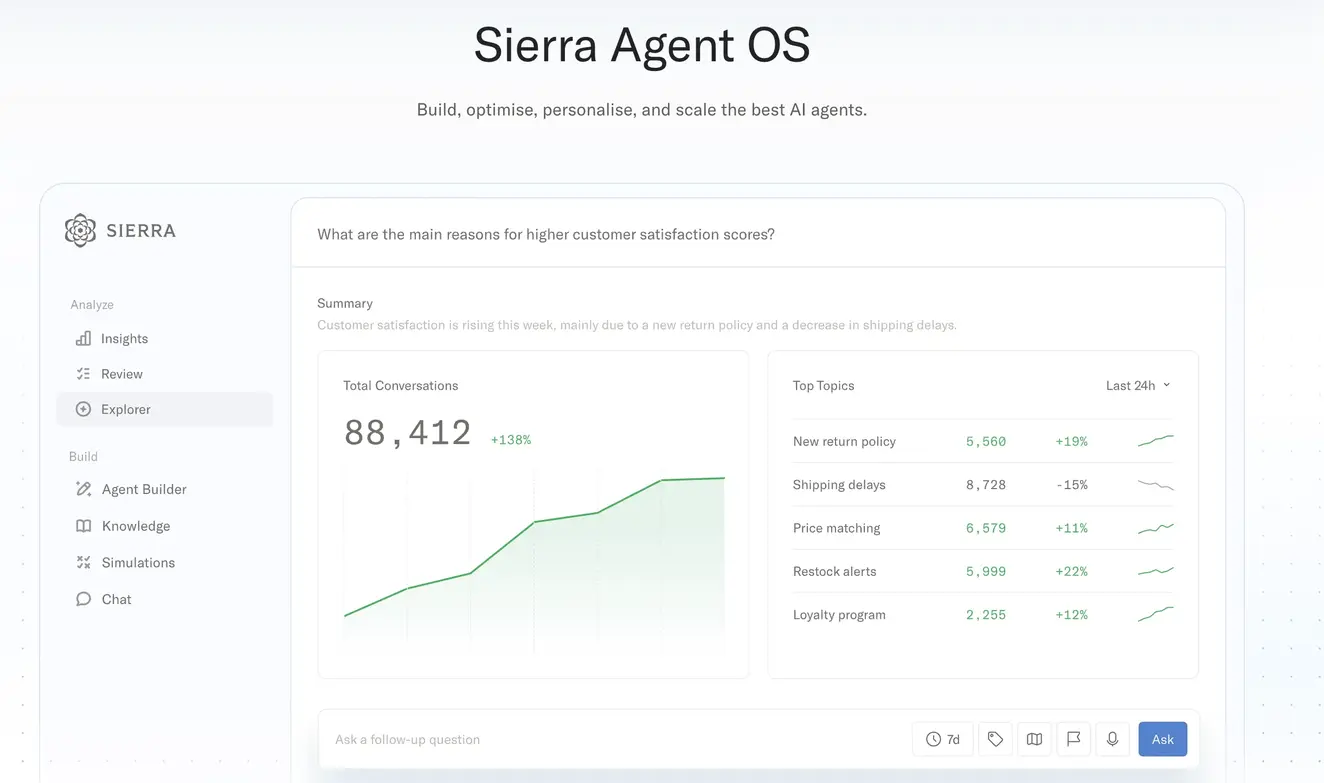
Sierra deploys a single agent across chat, SMS, WhatsApp, email, voice, and ChatGPT. Pricing is outcome-based, so you pay for resolved work rather than conversations. Teams can build agents with or without engineering support.
Pros
The widest channel list in this roundup.
Outcome-based pricing ties cost to results.
One agent and one set of rules across every channel.
Cons
No public pricing.
Enterprise sales process and rollout.
More platform than a small or mid-size store needs.
Choose it if you handle very high contact volumes and want pricing tied to outcomes.
4. Decagon: best for mid-market and enterprise support teams
Pick Decagon if your support team wants to design its own agent workflows and test them before launch.
Best for: Mid-market and enterprise support
Channels: Chat, email, voice
Order actions: Workflows written as Agent Operating Procedures
Integrations: Pre-built connectors
Starting price: On request
Free trial: Demo only

Decagon runs chat, voice, and email from one intelligence layer. Teams write Agent Operating Procedures (AOPs) to define workflows, then check them with simulations and live A/B tests before and after launch.
Pros
Chat, voice, and email share one brain and one set of rules.
Simulations and A/B tests catch weak answers before customers do.
Always-on QA flags problems after launch.
Cons
No public pricing.
Needs a CX ops owner to write and maintain AOPs.
Not built specifically for ecommerce.
Choose it if you have someone who will tune agent workflows every week.
5. Intercom Fin: best for teams already on Intercom
Pick Fin if your team already supports customers in Intercom.
Best for: Teams on Intercom
Channels: Chat, email, voice (Fin Voice)
Order actions: Ecommerce actions via integrations
Integrations: Intercom inbox and help center
Starting price: US$0.99 per outcome, plus seats from US$29/month
Free trial: 14 days
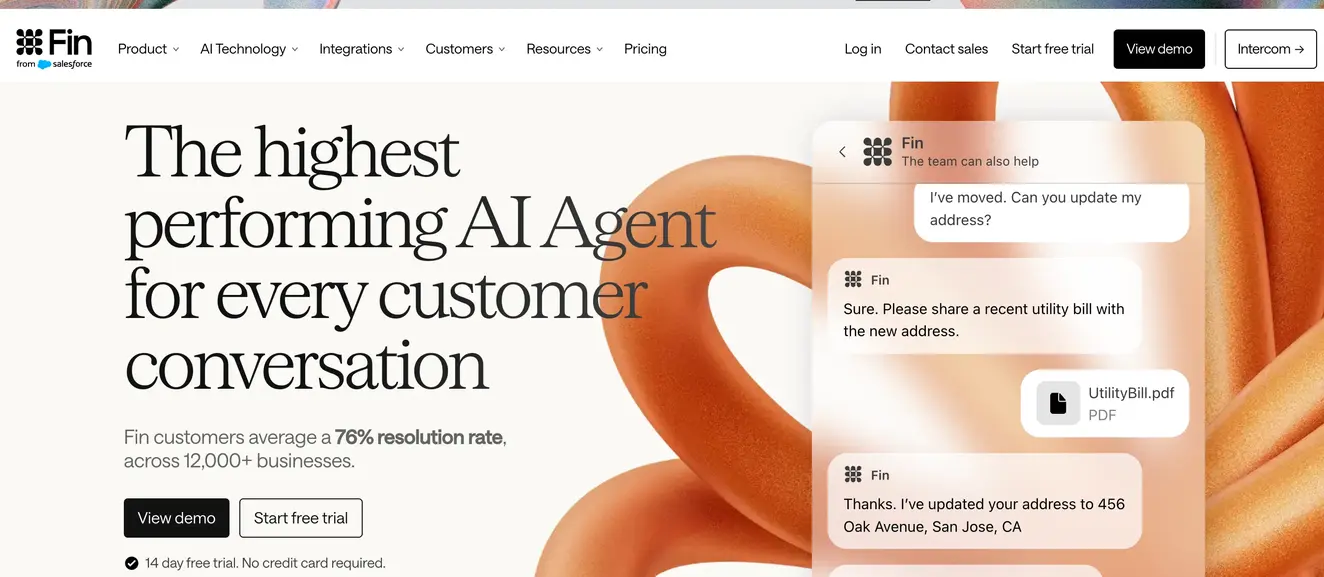
Fin answers in the Intercom Messenger, over email, and on the phone through Fin Voice, which handles calls like "where is my order?". Billing is per Fin outcome, on top of Intercom seats.
Pros
Works inside the Intercom inbox your team already uses.
Public per-outcome pricing.
Fin Voice adds phone support to the same agent.
Cons
Costs scale with both outcomes and seats.
Strongest inside Intercom; moving helpdesks to use it is a big project.
Ecommerce actions depend on the integrations you connect.
Choose it if Intercom is already your support home.
6. Zendesk AI agents: best for teams already on Zendesk
Pick Zendesk AI agents if Zendesk is already your helpdesk and you want AI on the channels it runs.
Best for: Teams on Zendesk
Channels: Every Zendesk channel, including voice
Order actions: Actions via AI Action Builder
Integrations: Zendesk marketplace apps
Starting price: Suite Team from US$55/agent/month (annual), plus per automated resolution
Free trial: 14 days
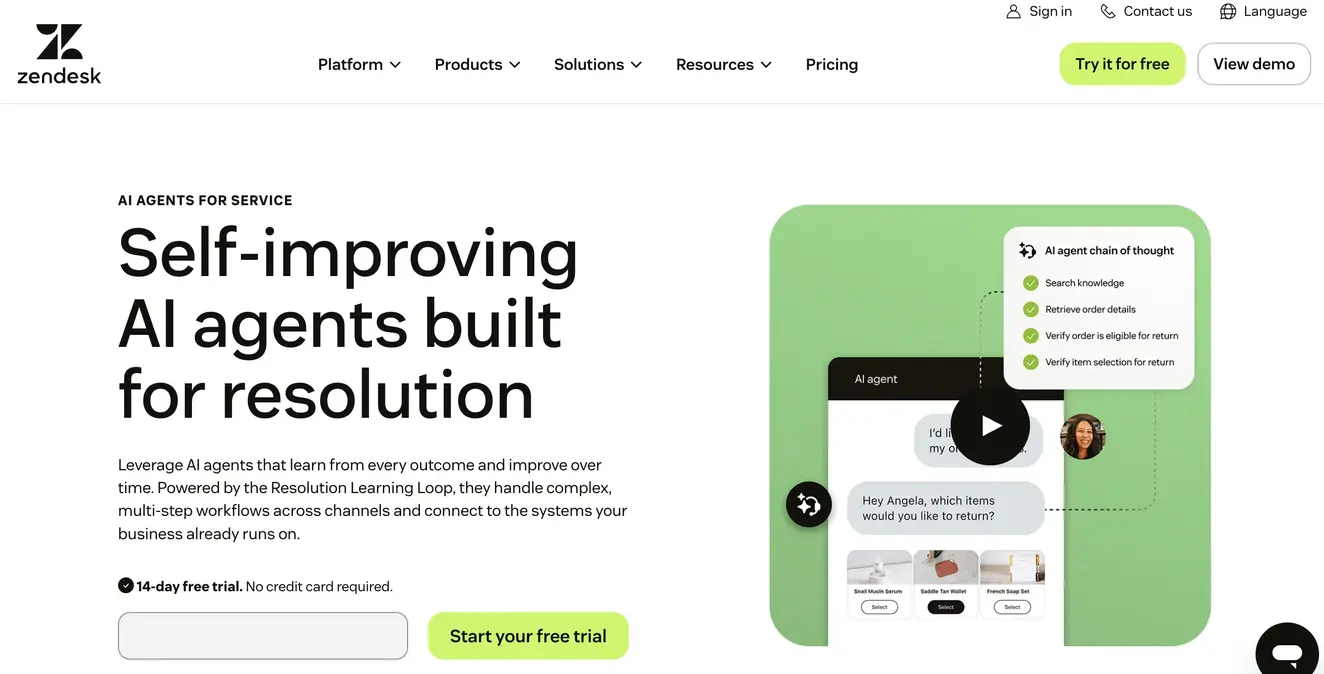
AI agents come with every Zendesk Suite and Support plan. You pay per automated resolution, meaning requests solved without a human. Suite Team adds an AI knowledge base and the AI Action Builder for actions in other systems.
Pros
No new tool for teams already in Zendesk.
Billed only on successful resolutions.
One agent across Zendesk's channels, including voice.
Cons
Needs Suite seats before AI usage fees.
Ecommerce actions need setup in the Action Builder.
Costs grow with both seats and resolutions.
Choose it if your team already lives in Zendesk.
7. Ada: best for multilingual enterprise support
Pick Ada if you serve customers in many languages and need one agent across voice, messaging, and email.
Best for: Multilingual enterprise support
Channels: Voice, chat, email, SMS, social
Order actions: Playbooks for order tracking, returns, exchanges
Integrations: Zendesk, Salesforce, Twilio
Starting price: Conversation-based, on request
Free trial: Demo only
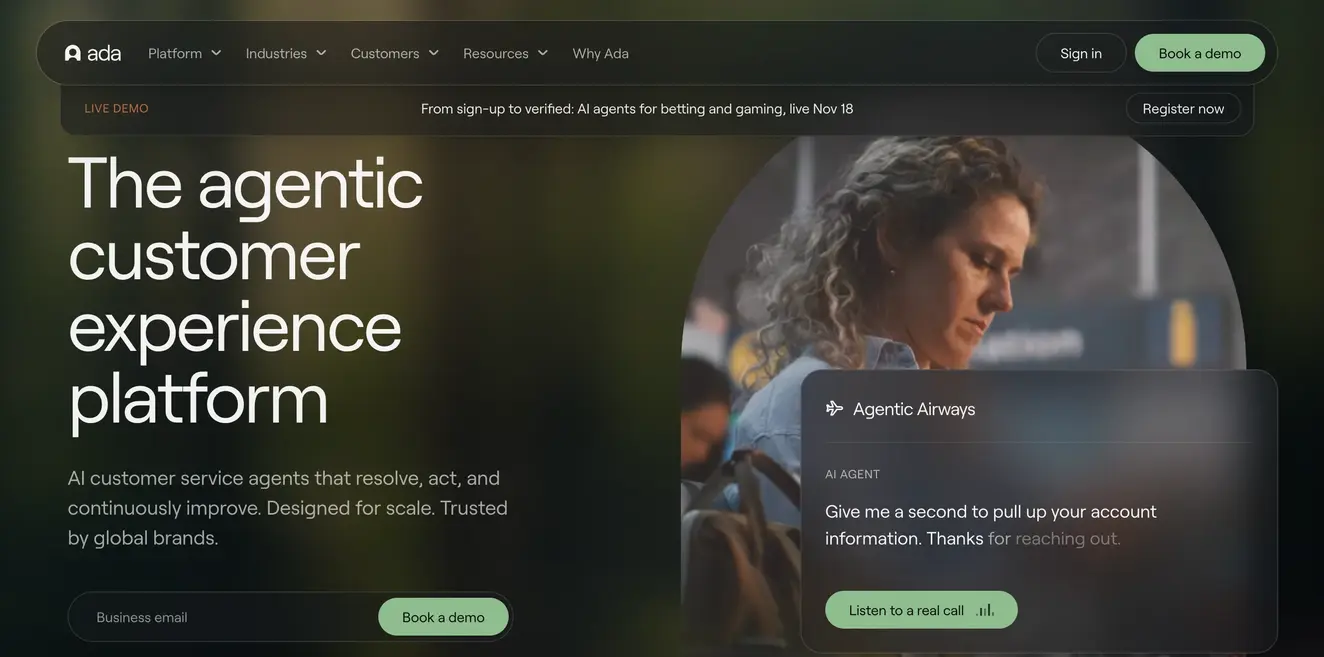
Ada runs one reasoning engine across voice, messaging, and email in 50+ languages. Playbooks turn multi-step processes, like a return, into automated workflows. You pay per conversation handled, whether or not it ends in an automated resolution.
Pros
50+ languages from one agent setup.
Playbooks automate multi-step returns and exchanges.
Built-in performance scoring flags weak resolutions.
Cons
No public pricing; third-party listings put entry contracts in the tens of thousands of dollars a year.
Billed per conversation, even when the agent hands off.
Language coverage differs by channel, so check voice separately.
Choose it if you sell across many markets and need the same support quality in each language.
8. Tidio Lyro: best for small stores on a budget
Pick Tidio if you run a small store and want an AI chat agent for a low monthly cost.
Best for: Small stores
Channels: Website chat; Lyro also runs inside other helpdesks
Order actions: Answers from your knowledge base
Integrations: Shopify, Zendesk, Salesforce
Starting price: US$24.17/month (annual), 50 Lyro conversations
Free trial: 7 days
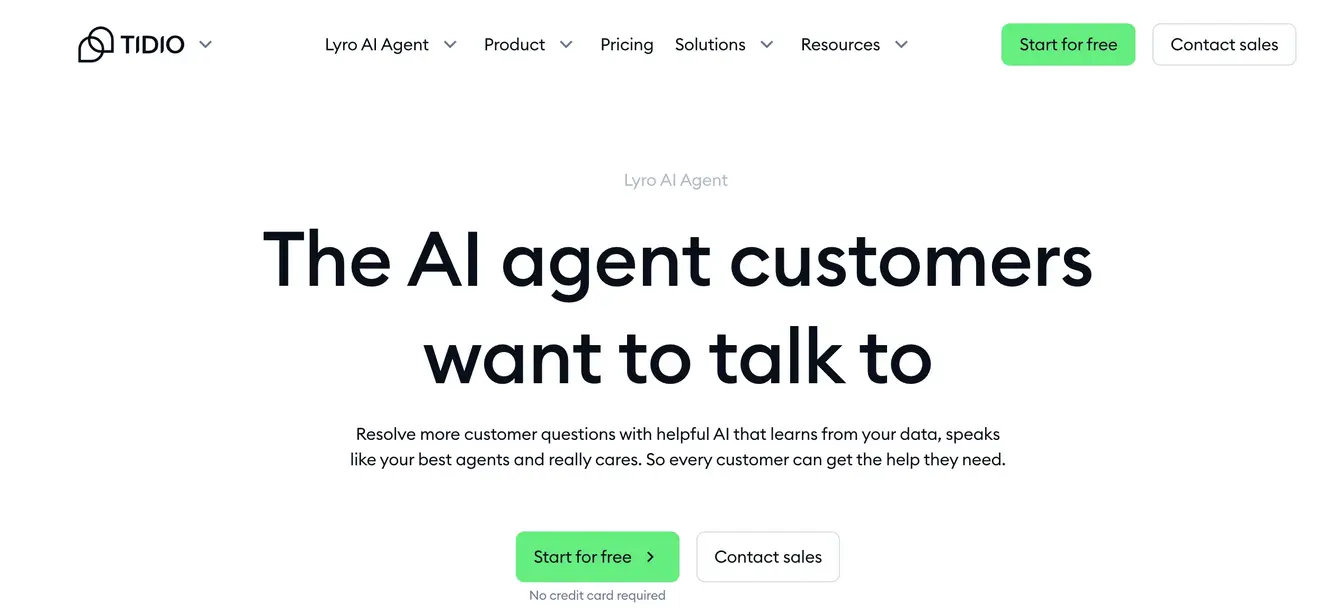
Tidio combines live chat, ticketing, and the Lyro AI Agent. The Starter plan includes 50 one-off Lyro conversations, then you pay for AI conversations as you go. Lyro can also run on its own inside Zendesk or Salesforce.
Pros
Lowest entry price on this list.
No-code setup with templates.
Lyro works standalone with other helpdesks.
Cons
50 included Lyro conversations go fast at peak.
Chat-first, with no phone channel.
Check which order actions your plan supports before Black Friday.
Choose it if budget matters most and your customers mostly use website chat.
9. Rep AI: best for Shopify pre-purchase conversion
Pick Rep AI if your goal is more checkouts, not fewer tickets.
Best for: Pre-purchase conversion
Channels: Website, email, Facebook, Instagram, WhatsApp
Order actions: Shopping guidance and support answers
Integrations: Shopify, Klaviyo, WooCommerce, Salesforce (175+)
Starting price: Custom plan
Free trial: 14 days
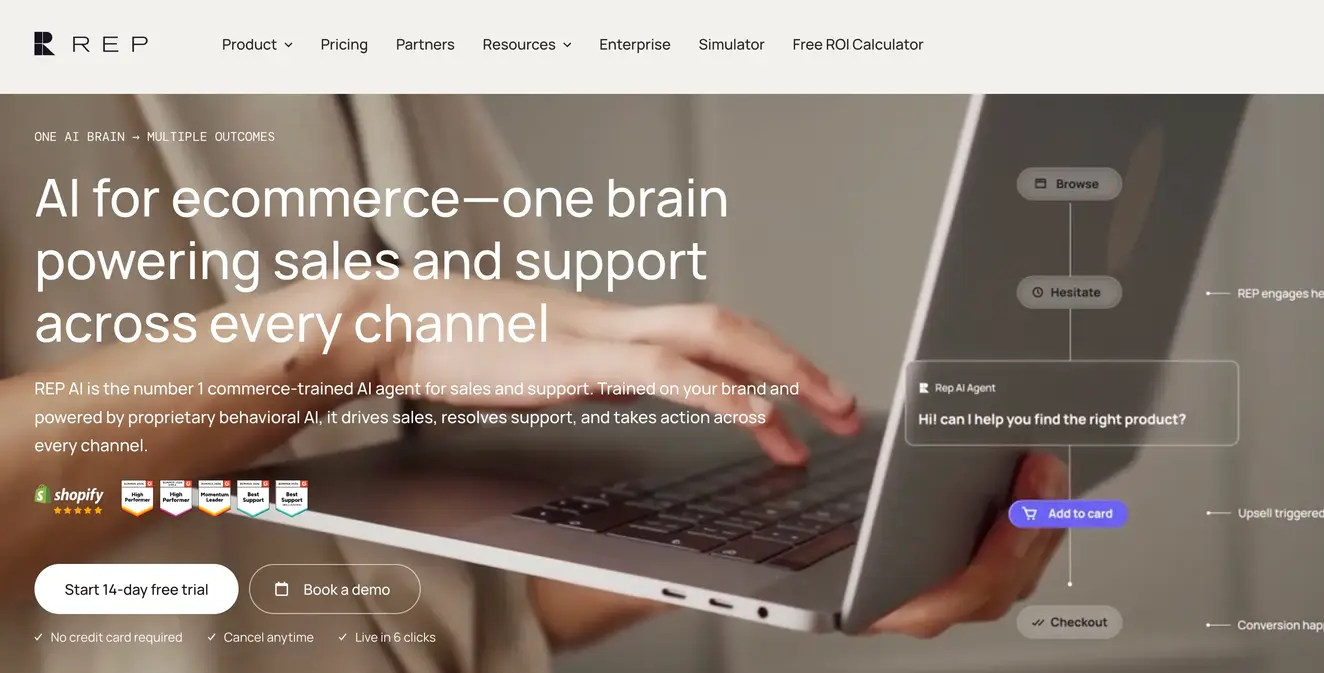
Rep AI tracks hundreds of behavioural signals, like hesitation and exit risk, and starts a conversation at that moment. It also resolves shopper questions before they become tickets, with a helpdesk in beta.
Pros
Proactive, behaviour-triggered conversations.
175+ integrations.
Built for conversion, with sales and support in one agent.
Cons
Pricing is built per plan, not published as a flat rate.
Strongest before purchase, not on post-purchase order work.
Helpdesk and omnichannel features are still in beta.
Choose it if conversion rate is your top metric.
How we chose the best AI agents for ecommerce
We scored each agent on six criteria, weighted toward the work that drives most ecommerce support volume: orders.
Order actions (25%): can it look up, change, cancel, or return an order, not just answer FAQs?
Channel coverage (20%): chat, email, SMS, WhatsApp, and phone.
Ecommerce integrations (20%): Shopify, other commerce platforms, helpdesks, and CRMs.
Time to go live (15%): can a support lead launch it without developers?
Pricing transparency (10%): is pricing public, and does it scale predictably?
Human handoff (10%): does the customer reach a person with full context when needed?
We checked features and prices on each vendor's site in October 2026. Customer-facing agents only: pricing, inventory, and marketing agents serve different teams and are covered below.
Which AI agent is right for your store?
Start with where customers reach you, then match the tool to the helpdesk you already run.
If your store... | Pick |
Gets order and delivery questions by phone, SMS, or WhatsApp | |
Runs support from a Shopify helpdesk on email and chat | Gorgias AI Agent |
Already supports customers in Intercom | Intercom Fin |
Already supports customers in Zendesk | Zendesk AI agents |
Handles very high volumes across regions and languages | Sierra, Decagon, or Ada |
Is small and wants the lowest monthly cost | Tidio Lyro |
Wants more conversions before checkout | Rep AI |
Many stores run two agents: a chat agent on the website and a voice agent on the phone line. If calls are where your peak-season backlog builds, start with the phone agent.
What are AI agents for ecommerce?
AI agents for ecommerce are software that understand a customer's request, check live store data, and take action, like looking up an order, starting a return, or rebooking a delivery. They hand off to a person when a case needs judgment.
What they handle for online stores:
Order status (WISMO): tracking, delivery dates, and carrier delays.
Returns and exchanges: eligibility checks and starting the return.
Order changes: address updates, cancellations, and rebooked deliveries.
Product questions: sizing, stock, and compatibility before purchase.
Proactive updates: calls or messages about delays before the customer asks.
Cart recovery: a timely nudge when a shopper hesitates at checkout.
Other AI agents run pricing, inventory forecasting, and marketing. They serve merchandising and ops teams, not customers, so they're outside this list.
How is an AI agent different from an ecommerce chatbot?
A chatbot follows a script. An AI agent understands intent and acts in your systems.
Rule-based chatbot | AI agent | |
How it answers | Fixed decision tree | Understands free-form questions |
What it can do | Share information | Take actions in Shopify, helpdesk, and CRM |
Off-script questions | Sends the customer to a form | Answers from your knowledge base |
Handoff | Customer starts over | Person gets the full transcript and context |
Why do "where's my order?" calls still reach your team?
Because the urgent cases pick up the phone. Tracking pages answer routine checks, but a late gift, a vague carrier status, or a missed delivery sends shoppers to the fastest route to a person.
The volume is real:
More than a quarter of retail and ecommerce agents' holiday interactions involve delivery status, based on Typewise's analysis of 10M+ chat and email interactions.
22% more sessions per week land on each support rep during peak, in the same study.
Calls don't keep business hours. Shoppers buy late at night and on weekends, often after your team logs off.
Those numbers come from chat and email alone. Phone adds its own spike, and a caller on hold can't wait for a reply the way an email can.
An AI agent on the phone line clears the routine calls so your team handles the exceptions. Food Cycle Science saw 4.5x faster response times after adding Aircall AI Agents, and its Head of Customer Service and Experience says callers were surprised how easy the agent was to talk to.
Hear a sample order call: listen to the AI order management agent handle a "where's my order?" call from greeting to closed ticket.
How do you set up an AI agent for ecommerce?
Most stores can go live in five steps, starting with one high-volume request rather than everything at once.
Pick your top 3 requests. Pull a month of tickets and calls. Order status, returns, and delivery changes usually lead.
Connect your systems. Link Shopify (or your commerce platform), your helpdesk, and your CRM so the agent can read and update orders.
Set handoff rules. Decide which requests always go to a person, like damaged items, VIP customers, or refunds above a set amount.
Test with real requests. Try clear questions, vague ones, and pushback before going live.
Track resolution rate weekly. Watch resolution rate, transfer rate, and customer satisfaction, then fix the knowledge gaps the agent flags.
Set it up at least a month before peak season, so the agent has real conversations behind it when volume spikes.
Try Aircall's AI Order Agent for free
Frequently asked questions
What is the best AI agent for ecommerce?
The best AI agent depends on your channels. Gorgias suits Shopify stores running email and chat support. Sierra, Decagon, and Ada suit enterprise teams. Aircall's AI order management agent is the best fit when order and delivery questions arrive by phone, SMS, or WhatsApp, because telephony is included.
How much do AI agents for ecommerce cost?
Pricing ranges from about US$24 a month for small-store chat agents to custom enterprise contracts. Most tools charge per resolution, per conversation, or per minute. Aircall's AI Voice Agents include 50 free minutes every month, then cost A$0.44 per minute. Prepaid bundles bring the rate down to A$0.34 per minute, and custom plans for 10,000+ minutes start at A$0.29 per minute. See the full AI voice agent cost breakdown.
Can an AI agent answer phone calls for an online store?
Yes. Voice AI agents answer calls, understand the request, and act in your systems while the customer is on the line. Aircall's AI order management agent answers order status, return, and delivery calls 24/7 and updates Shopify during the call.
Do AI agents work with Shopify?
Yes. Most agents on this list connect to Shopify to read order and shipping data. The stronger ones also write back, like updating an order or starting a return. Aircall connects to Shopify natively through its Shopify integration.
Will an AI agent replace my support team?
No. AI agents take the repetitive requests, like order status, tracking, and simple returns. Your team handles the cases that need judgment or empathy, and receives them with the full conversation attached, so customers never repeat themselves.
How long does it take to set up an AI agent?
Simple setups with templates go live in days. Enterprise rollouts with custom workflows take weeks to months. With Aircall, you start from a preset order management template, add your knowledge base, set handoff rules in plain language, test, and publish.
Are AI agents safe for customer data?
They can be, if the vendor holds recognised certifications and controls what data the agent can access. Ask for SOC 2 Type II, GDPR, and CCPA compliance at minimum. Aircall meets all three and stores call transcripts and recordings in the EU.
Published on .
Ready to build better conversations?
Simple to set up. Easy to use. Powerful integrations.
Get free access