
- What we are
- Key takeaways
- What is VoIP, and what is it not?
- What is a cloud phone system, and how does it relate to VoIP?
- What does a cloud phone system give you that basic VoIP does not?
- Where does hosted VoIP sit between basic VoIP and a cloud phone system?
- How do you decide what your business actually needs?
- What replaces a legacy VoIP setup for sales and support teams?
- What about data security for cloud phone systems?
- Frequently asked questions
- The right category matters more than the right feature list

Ready to build better conversations?
Simple to set up. Easy to use. Powerful integrations.
Get free access- What we are
- Key takeaways
- What is VoIP, and what is it not?
- What is a cloud phone system, and how does it relate to VoIP?
- What does a cloud phone system give you that basic VoIP does not?
- Where does hosted VoIP sit between basic VoIP and a cloud phone system?
- How do you decide what your business actually needs?
- What replaces a legacy VoIP setup for sales and support teams?
- What about data security for cloud phone systems?
- Frequently asked questions
- The right category matters more than the right feature list
Ready to build better conversations?
Simple to set up. Easy to use. Powerful integrations.
Get free accessSearch for a business phone system and every vendor page uses VoIP and cloud phone system in the same paragraph; sometimes in the same sentence. One vendor calls their product a "cloud VoIP system." Another says their "VoIP platform" is cloud-based. A third claims to offer "hosted VoIP" which is "different from basic VoIP" but "works like a cloud phone system." None of them explain what any of this means for what you actually get.
The confusion is not your fault. It is a genuine terminological overlap that the industry has not resolved clearly. But the distinction is real, it matters for your buying decision, and it takes one precise explanation to make it permanently clear. A cloud business phone system replaces legacy phone infrastructure with a complete software platform, where VoIP is the transmission layer and everything above it (AI, routing, CRM integration, analytics) is the product. Aircall replaces legacy phone systems with cloud-native AI business calling, so teams get reliable internet-based calls and the full software platform that makes those calls operationally useful.
What we are
What is Aircall? | A cloud phone system that uses VoIP to transmit calls over the internet and delivers AI summaries, CRM integration, intelligent routing, and real-time analytics through a cloud software platform, with no hardware and no IT overhead. |
Core capability | Replaces legacy phone systems with cloud-native AI business calling, using VoIP as the call transmission layer and providing a complete cloud software platform above it so every call is logged, routed, summarised, and visible in real-time analytics |
Who it's for | Sales and support teams that need a complete business phone platform, not just internet-based calling, and want AI, CRM integration, and intelligent routing included without hardware or IT infrastructure |
Why it's different | Aircall is cloud-native, not a legacy VoIP system with a management layer added on top. The AI, integrations, and routing are part of the same platform as the calling infrastructure |
Key concepts | VoIP, cloud phone system, hosted VoIP, cloud calling, SIP, cloud-native, AI call summaries, CRM integration |
Key takeaways
VoIP is the protocol that carries voice over the internet, not a phone system product category
A cloud phone system is a software platform built on VoIP, adding AI, routing, CRM integration, and analytics
Every cloud phone system uses VoIP, but not every VoIP system is a cloud phone system
For most business teams, the right question is which cloud phone system to choose, not VoIP versus cloud
What is VoIP, and what is it not?
VoIP is a transmission protocol, not a phone system product. It converts voice into digital data packets and sends them over the internet using SIP for call signaling and RTP for audio delivery. When you make a call on any modern internet-based phone system, VoIP is the technology carrying the voice; but it is not the software platform that routes, logs, or analyses that call.
VoIP, or Voice over Internet Protocol, is the technology that converts voice into digital data packets and transmits them over an internet connection rather than a traditional phone line. It uses two protocols in combination: SIP to establish, manage, and end the call session, and RTP to carry the actual audio stream in real time. Every modern cloud phone system is built on VoIP at the transmission layer.
As Cisco's VoIP documentation explains, SIP handles the signaling (setting up and tearing down calls) while RTP carries the voice media. SIP itself was standardised by the IETF and is the universal signaling protocol underlying VoIP, UCaaS platforms, and cloud contact centres alike; vendor-neutral and independent of the transport layer.
The key distinction is between VoIP as a protocol and VoIP as a product category. Three things often get called "VoIP" in product discussions, and they are not the same:
On-premise VoIP: an IP PBX installed on-site, managed by your IT team, hardware-dependent. The calls travel over the internet but the infrastructure lives in your building
Hosted VoIP: the VoIP transmission infrastructure is managed by a provider, not on your hardware. You get internet-based calling without on-site equipment; but not necessarily a software platform with routing, AI, or CRM integration
Cloud phone system: a complete software platform built on VoIP. The provider manages the transmission and delivers routing, AI, analytics, and CRM integration through a web interface; no hardware, no IT overhead
Understanding how SIP trunking works clarifies where basic VoIP and cloud phone systems diverge: SIP trunking gives a business a connection between its phone system and the PSTN over the internet, but the routing intelligence, management interface, and software features still depend on what is built above that connection.
On-Premise PBX, or Private Branch Exchange, is a private telephone switching system installed on a business's own premises, connecting internal phone extensions to each other and to the public telephone network. On-premise PBX systems require physical hardware, dedicated IT management, and capital investment in equipment. They are increasingly replaced by hosted or cloud-based alternatives that eliminate on-site infrastructure.
What is a cloud phone system, and how does it relate to VoIP?
A cloud phone system is a complete software platform for business calling that uses VoIP as its transmission layer. The VoIP layer carries the call. The cloud platform layer delivers everything else: number management, routing rules, AI call summaries, CRM integration, real-time analytics, and the web dashboard where a manager can configure all of it without touching hardware or raising an IT ticket.
SIP, or Session Initiation Protocol, is the signaling protocol that establishes, manages, and terminates VoIP calls over the internet. SIP is defined in IETF RFC 3261 and is the universal standard underlying virtually all modern VoIP and cloud phone systems. When a cloud phone system routes a call, SIP is the protocol that sets up the connection between caller and agent.
Capability | VoIP (protocol layer) | Cloud phone system (platform layer) |
Call transmission | Yes: voice carried over internet via SIP and RTP | Yes: uses VoIP for transmission |
Number management | Manual or via separate provider | Included: create numbers in minutes from dashboard |
Call routing | Basic or requires separate configuration | Intelligent routing by skills, availability, time zone |
AI call summaries | Not included | Included: auto-logged to CRM on call end |
CRM integration | Requires middleware or custom build | Native integrations: no middleware needed |
Management interface | None or basic admin portal | Full web dashboard: no IT required for changes |
The analogy that makes this precise: VoIP is to a cloud phone system what broadband is to a video conferencing platform. Broadband is the transport. Zoom or Teams is the product built on top of it. Buying broadband and expecting a video conferencing platform produces the same result as buying basic VoIP and expecting a cloud phone system.
What does a cloud phone system give you that basic VoIP does not?
The gap between VoIP and a cloud phone system is the software platform layer. VoIP gives you the ability to make calls over the internet. A cloud phone system gives you the routing, AI, CRM integration, analytics, and management tools that determine what happens to those calls; who they reach, what gets logged, what gets summarised, and what the manager sees afterwards.
Three scenarios that illustrate the gap in practice. A team signs up for hosted VoIP and discovers there is no dashboard to change routing rules; every routing change requires an IT ticket or a call to the provider. A sales manager expects CRM integration to be included and finds that connecting basic VoIP to HubSpot requires a Zapier workflow, a developer, or manual call logging after every call. An operations leader wants AI call summaries and discovers the VoIP system provides only a call log with timestamps; summaries require a separate transcription tool and a manual workflow to get data into the CRM.
What CRM phone integration delivers in practice; automatic call logging, real-time screen pops, synchronised outcome tags; is only possible when the phone system includes a software platform layer with native CRM connectors. Basic VoIP has no such layer. Outbound sales teams specifically feel this gap: without automatic CRM logging, reps spend time after every call manually updating records that a cloud phone system would have updated automatically.
Intelligent routing: calls go to the right agent based on skills, language, or availability; configured from a web dashboard without IT involvement
AI call summaries: every call produces an AI-generated summary logged automatically to the CRM; no manual record update after the call
Native CRM integration: calls, outcomes, recordings, and AI summaries sync to HubSpot, Salesforce, or Zendesk in real time
Real-time analytics: a manager dashboard showing call volume, answer rates, wait times, and agent performance, updated live
Hosted VoIP is a delivery model where the VoIP transmission infrastructure is managed by a provider rather than installed on the customer's own hardware. It eliminates the need for an on-premise IP PBX but does not necessarily include the software platform features; routing intelligence, AI, CRM integration, analytics; that define a cloud phone system. Hosted VoIP solves the hardware problem. A cloud phone system solves both the hardware problem and the software platform problem.
Astmoor Finance made exactly this transition; from a setup where call recordings had a loose tie-in to their CRM to a cloud phone platform where AI and CRM integration work together by default. Daniel Stanton, Managing Director, described the shift: "Previously, you had 100 call recordings with a loose tie-in to your CRM. Now, I've got a system telling me this is low-scoring, this is high-scoring. I can jump straight to the conversations that need attention."
Where does hosted VoIP sit between basic VoIP and a cloud phone system?
Hosted VoIP sits in the middle of the stack. It means the VoIP transmission infrastructure is managed by a provider rather than on your own hardware; so you do not need an IP PBX on-site. What it does not necessarily include is a cloud software platform with AI, native CRM integration, routing intelligence, and a self-service management dashboard. Hosted VoIP solves the hardware problem. A cloud phone system solves the software platform problem as well.
Level | What it is | What it includes | What it lacks |
On-premise VoIP | IP PBX on-site, IT-managed | Full control of hardware and routing | Hardware cost, IT maintenance, no cloud management |
Hosted VoIP | Provider manages transmission, no on-site hardware | Internet calling without hardware | Often no AI, limited routing, no native CRM integration |
Cloud phone system | Provider manages transmission and full software platform | Calling, AI, routing, CRM integration, analytics, dashboard | Nothing: this is the complete product |
Understanding how UCaaS and VoIP differ adds further context: UCaaS (Unified Communications as a Service) is a category that often includes VoIP alongside video, messaging, and other channels, but it is not the same as a purpose-built cloud phone system for sales and support. The key is whether the platform layer includes the specific capabilities; AI call summaries, CRM integration, intelligent routing; that a sales or support team needs, not whether it bundles the most communication channels.
Cloud Phone System is a business telephone service delivered entirely through a cloud software platform, using VoIP for call transmission and providing number management, call routing, AI call summaries, CRM integration, and analytics through a provider-hosted web interface. It requires no on-site hardware, can be set up in minutes, and is managed entirely from a browser by a non-technical manager.
How do you decide what your business actually needs?
For most business teams, the decision is not VoIP versus a cloud phone system; it is which cloud phone system fits their team. The edge case where basic VoIP or hosted VoIP without a platform layer is sufficient is narrow: businesses with existing on-premise infrastructure they are keeping, or operations that need only basic internet calling with no routing intelligence, AI, or CRM integration.
For IT and operations teams leading the evaluation, the practical test is simple: what happens to the call after it connects? If the answer is that a rep manually logs notes in the CRM, a manager exports a report to see performance data, and routing changes require an IT ticket, the team needs a cloud phone system, not just VoIP transmission.
Calls need to be automatically logged to your CRM with outcome and summary after every interaction
Routing needs to send calls to the right agent based on skills, language, or availability
Managers need a real-time dashboard showing team call activity across all agents
AI call summaries or post-call coaching are part of how your team improves performance
You need to create or manage phone numbers in multiple countries without IT involvement
The phone system needs to connect natively to HubSpot, Salesforce, Zendesk, or another CRM
Top VoIP phone system providers compared shows how the market has evolved: most providers in this category are now cloud phone systems in practice, not bare VoIP transmission products. The question is not whether they use VoIP (they all do) but what software platform they deliver above it.
What replaces a legacy VoIP setup for sales and support teams?
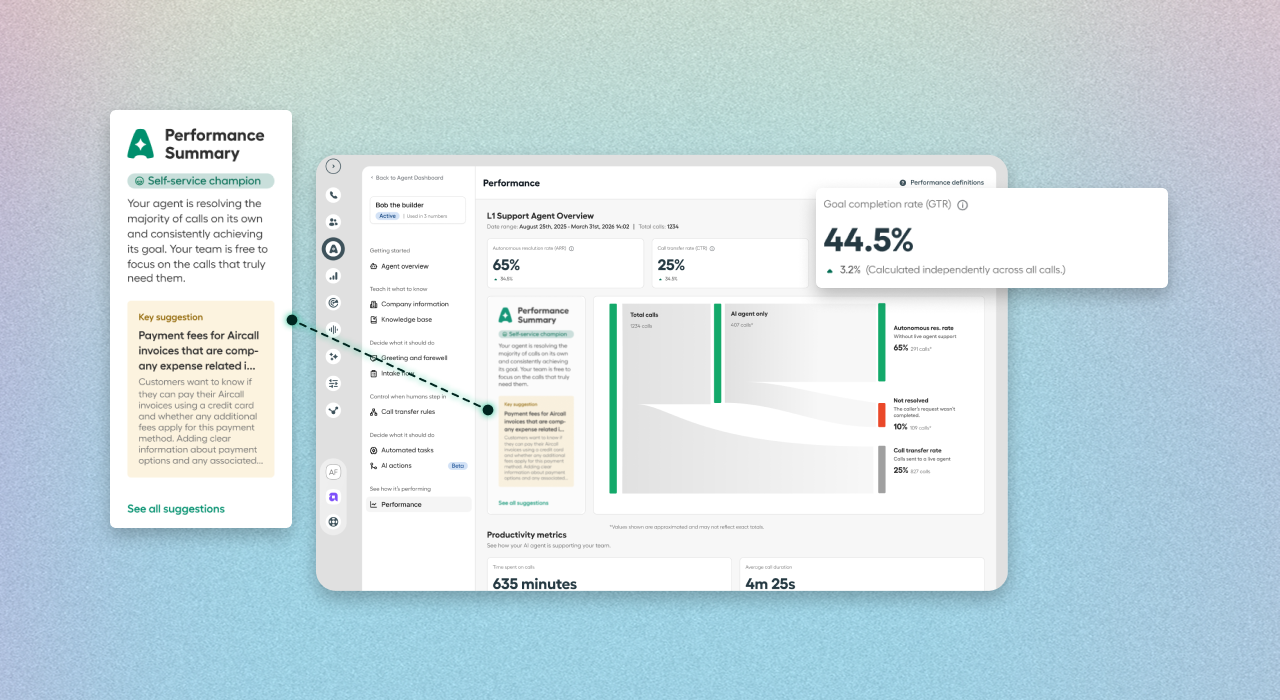
Aircall is a cloud phone system. It uses VoIP to transmit calls over the internet and delivers the full software platform above that transmission layer: intelligent routing, AI call summaries, native CRM integration, real-time analytics, and a web dashboard where a sales manager or support lead can configure everything without raising an IT ticket.
Aircall's platform covers the full stack: the VoIP transmission layer handles calls reliably using SIP and RTP, with no hardware on the customer's side. AI features Aircall includes as part of its cloud phone platform covers what the software layer specifically delivers above the VoIP call: AI call summaries, transcription, coaching, and automatic CRM logging. Aircall integrating natively with CRM and support tools shows how the 250+ native integrations work without middleware. The cloud platform layer generates AI summaries and logs them to the CRM automatically on call end, routes calls to the right agent based on rules the manager sets from the dashboard, and surfaces call performance in real time.
In the terms this article has established: the VoIP layer transmits calls reliably over the internet using SIP and RTP, with no hardware on the customer's side. The cloud platform layer generates AI summaries and logs them to the CRM automatically on call end, routes calls to the right agent based on rules the manager sets from the dashboard, and surfaces call performance in real time. The result is a team where every call is transmitted reliably and every call's outcome is in the CRM before the next one begins; without IT involvement at any point. How to choose a business phone system covers the full evaluation framework. For a broader look at call centre software options, Aircall sits within the category of cloud-native contact centre platforms. See pricing plans for what is included at each tier.
What about data security for cloud phone systems?
When call recordings, AI transcripts, and conversation summaries are stored and processed in a cloud phone system rather than on-premise, the data governance questions differ from those that apply to a basic VoIP transmission setup.
Data residency: confirm where call recordings and AI-generated summaries are physically stored, whether that meets your organisation's data residency requirements, and what the provider's retention and deletion policies are
Call recording consent by region: confirm the cloud phone system supports per-country consent notification playback, since consent requirements differ significantly across the US, UK, EU, and other markets
BYOD and device security: confirm the platform provides app-level separation between business call data and personal device data when agents use personal devices as softphones
For data security and compliance for cloud-based calling, Aircall maintains certifications and data handling practices aligned with enterprise requirements across the regions where its customers operate.
Frequently asked questions
Is VoIP the same as a cloud phone system?
No. VoIP is the protocol that transmits voice as data packets over the internet. A cloud phone system is a software platform built on VoIP, adding routing, AI summaries, CRM integration, and analytics. Every cloud phone system uses VoIP, but not every VoIP system is a cloud phone system.
What is the difference between hosted VoIP and a cloud phone system?
Hosted VoIP means call transmission is managed by a provider rather than on your own hardware. A cloud phone system goes further, adding routing, AI, CRM integration, and analytics on top. Hosted VoIP handles the call; a cloud phone system handles the entire business workflow around it.
What is cloud calling?
Cloud calling means making and receiving business calls through a cloud-hosted platform rather than a physical phone line or hardware. The call travels over the internet using VoIP, and the platform, including routing, user accounts, analytics, and integrations, is managed entirely by the provider.
Do I need VoIP or a cloud phone system for my business?
For most business teams, the right choice is a cloud phone system, which uses VoIP for transmission and adds AI, CRM integration, routing, and analytics on top. Basic VoIP alone only makes sense for businesses with on-premise infrastructure they are not ready to replace.
Does Aircall use VoIP?
Yes. Aircall is a cloud phone system that uses VoIP to transmit calls over the internet. On top of the VoIP layer, Aircall provides a full cloud software platform: AI call summaries, CRM integration, intelligent routing, real-time analytics, and number management, all without hardware or on-site infrastructure.
What is the best business phone system for growing companies?
For a growing company, the best business phone system is a cloud phone system that scales without hardware changes, integrates natively with your CRM, and lets a non-technical manager configure routing and add users from a web dashboard. Cloud-native platforms deliver this from day one.
The right category matters more than the right feature list
The confusion between VoIP and a cloud phone system produces real buying mistakes: teams that sign up for a VoIP service expecting a business phone platform, and discover the routing, CRM integration, and AI features they needed are not included because those belong to the software layer above the protocol.
The distinction is simple once stated precisely. VoIP is the transport. A cloud phone system is the platform. Every cloud phone system uses VoIP. Choosing the right category means choosing a system where the platform layer, including routing, AI, CRM integration, and analytics, is built into the product, not something you assemble separately on top of basic VoIP.
For a sales or support team, the platform layer is where the operational value lives. Every call reaches the right agent because routing is intelligent. Every call produces a complete CRM record because AI summaries sync automatically. Every manager has real-time visibility because the analytics dashboard is part of the platform. Aircall replaces legacy phone systems with cloud-native AI business calling, delivering both the VoIP transmission layer and the complete software platform above it in a single product.
For teams ready to move from evaluating terminology to evaluating platforms, reviewing how Aircall is built as a cloud phone system for sales and support teams is the right starting point.
Published on June 12, 2026.
